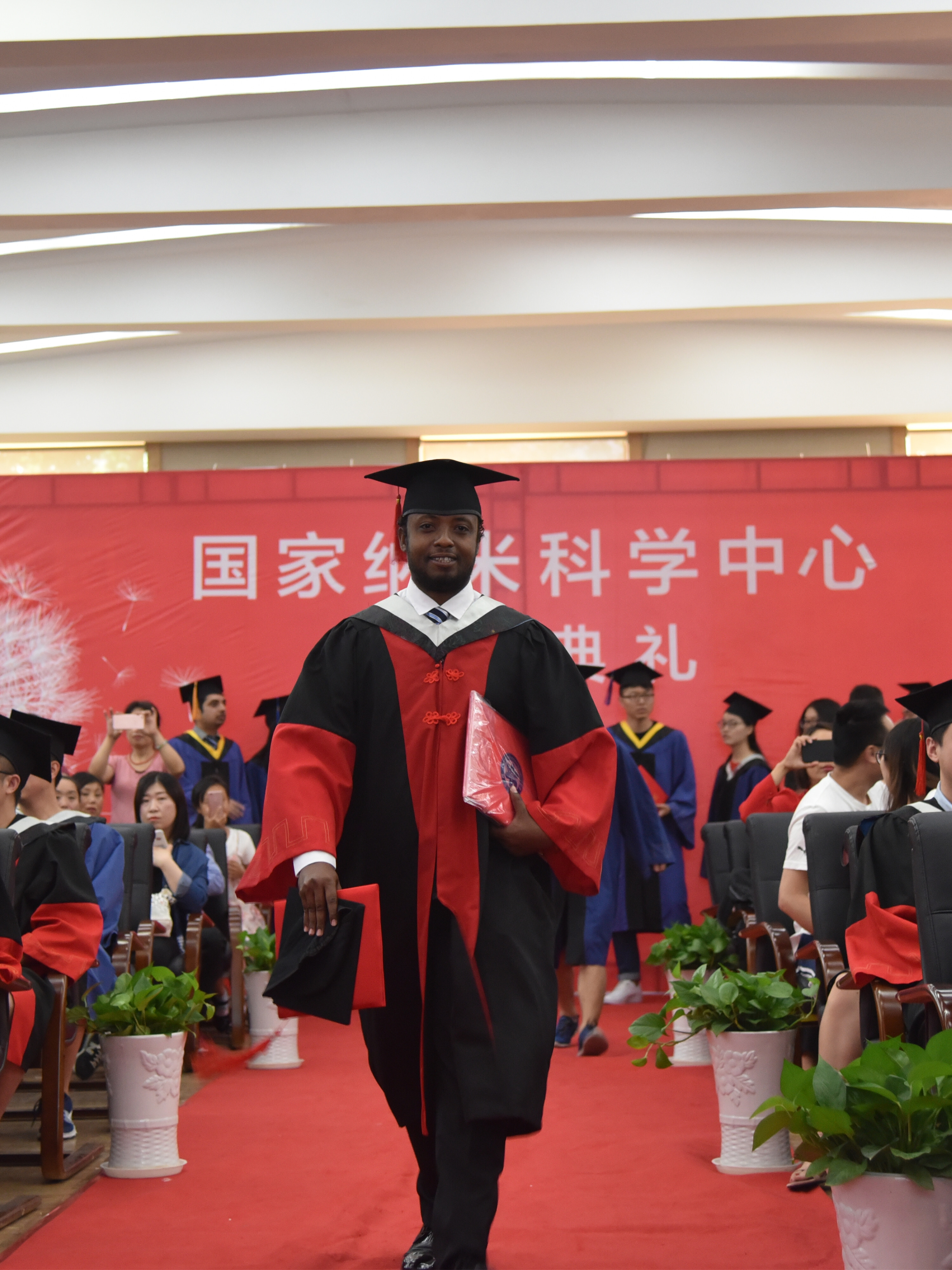

Beijing is the first city in the history of my international travel. The time I came to Beijing to pursue my PhD, I was with full of courage and motivation. The environment, weather condition, culture and traditions were all new for me. Chinese people are keen to help foreigners and I was open minded to get used to new environments.
When I began studying at National center for nanoscience and technology (NCNST), I was simultaneously taking Chinese language course. The later task coupled with working full-time in the lab ended up being much more stress full than I could have imagined.Through time, I got used to it and the situations became better and better. I have always been passionate about science.The enormous hospitality from the UCAS and graduate school of NCNST keeps me motivated.The team sprit and and hard working habit of the members in the research group I joined, the students’ strong commitment for work, their inspiring courage towards accomplishing the assignment given to them, their culture of respecting with each-other will remain in my mind forever. I got a fertile ground to philosophize the depth of nanoscience and technology. I focused on controllably synthesizing functional nanomaterials for water splitting via electrocatalysis or photocatalysis. My research is always my purpose. I specifically focused on growing different kinds of layered materials: transition metal dichalcogenides (MX2, X= S or Se) and metal phosphorus trichalcogenides ( MPX3). These materials have attracted a tremendous amount of interest due to their promising energy applications and striking fundamental properties. Considering the effective charge/ electron transport properties, appreciable stability for catalysis and immensely exposed active sites, different materials of these families have been utilized for catalysis of water splitting reactions. Various strategies have been followed to develop TMD based electrocatalysts. Of the many approaches to improve the intrinsic activities of TMD’s catalysis, doping and hybrid material formation are believed to play significant role in optimizing the free energy of Hydrogen atom adsorption and Hydrogen molecule desorption. A well- matched hybrid material between WS2 and rGO ( Nanoscale 2015,7,14760-14765), phase pure CoxW(1-x)S2 ( Small 2016,12,No.28,3802-3809), WS2(1-x)P2x ( Small 2017,13, No.16, 1603706) were controllably synthesized and investigated for electrocatalyzing HER. In order to alleviate the effect of paucity of active sites, a vertical orientation was designed for WS2 nanosheets, ensuring a fertile ground for large area sensitization with rGO which inturn realizes a very good synergism between them. Moreover, experimental and theoretical investigations reveal that metal or chalcogen doped TMDs are more active and efficient than the undoped binary ones. Although cobalt and phosphorus are theoretically predicted to significantly promote the catalytic activities of TMDs, it has been challenging to synthesize CoxW(1-x)S2 and WS2(1-x)P2x without any concomitant side phases hitherto. A rational method to synthesize pure CoxW(1-x)S2 nanosheet and WS2(1-x)P2x nanoribbon to demonstrate a conspicuously enhanced catalysis toward HER has also been studied.
From the aspect of photocatalysis, a new class of layered materials, known as transition metal phosphorus trichalcogenides (MPX3) were explored for catalytic water splitting. These materials posses high chemical diversity and wide range of application in broad wavelength spectrum as compared to MX2 materials. However, experimental efforts have so far been challenged with the synthesis bottleneck. A systematic chemical vapor deposition route was developed to grow high crystal quality MnPS3 and MPSe3 ; both of which demonstrated promising activities toward photocatalytic water splitting reaction ( Adv. Func. Mater. 2018, 28,1800548).
Apart from the research works, I had an ample opportunity to work in close collaboration with the graduate school of NCNST in various extra-curricular activities. For instance, I hosted the 2015 summer camp,and the 2017 Nanotrip events.I also guided visitors who came from various parts of the world to attend Erasmus NanoEl in August 2017.
So much so about my four years duration at NCNST. I have now completed my PhD in Physical chemistry. In addition to my academic achievement, I learned new and important culture from China that would be significant input for shaping my future life. , Undoubtedly, I will be missing many things.
Tofik Ahmed (PhD)