


Since my young age in Malaysia, I have been fascinated by the 5000-year civilization of China and feel proud of my family lineage originated from Fujian, China. In Malaysia, we are fortunate to learn Mandarin in our primary and secondary schools. With my passion for Chinese literatures and cultures, I enjoy reading various Chinese books during my free time including Three Kingdoms, Journey to the West, Water Margin etc. Thus, I am really excited when I have an opportunity involved in this PIFI program, which allow me to stay longer in Beijing. It allows me to explore more about the capital city of China especially the local cultures, foods, community and historical buildings. For Beijing, it is worthwhile to highlight the forbidden city, which is so much attractive to me on how wonderful and greatness of ancient civilization of China from Ming to Qing Dynasties. Furthermore, the great wall of China (Wanli Changcheng) is also one of the seven wonders in the world with the world longest walls, which was built for more than 2000 years ago with selective stretches to prevent invasion from outsides and later joined by Emperor Qin Shi Huang to form the world longest wall.
Beijing has very good research and academic environment for academician and students: Zhongguancun is an academic village with vibrant scholar environment. The surrounding area consists of various research institutes for Chinese Academy of Sciences and world-class high education institutes including Peking University, Tshinghua University, Chinese People University, Beihang University etc. More importantly, Beijing is indeed a green, beautiful and well-organized metropolitan city with special lanes for bicycles, well-connected public transports (buses & MRT) and many electric vehicles on the roads. Although the traffic is very busy, we can still manage to cycle to the National Center for Nanoscience and Technology (NCNST) every day. Rental bicycles are easily accessible throughout the city with reasonable charges using Mobile Apps, which is extremely convenient and affordable. The almost cashless society is one of the note-taking success stories in China, where e-wallets such as Alipay and WeChat pay, are very efficient and convenient in various transactions. All the online purchases via Mobile Apps are very efficient and fast in delivery within acceptable timeframe, where the food order can be delivered within 30 minutes. In overall, the lifestyle in Beijing has reached the status of developed countries that I have ever visited throughout my academic career.
It is indeed my great honor to be awarded as an international visiting scientist under the Chinese Academy of Sciences President's International Fellowship Initiative (CAS PIFI) to work for the title namely "Tailoring band-gap of organic photovoltaic device to optimize power conversion efficiency based on local spectral irradiance in China". During the research visit, I really enjoy working with both Prof. Dr Zhou Huiqiong and Dr Zhang Hong, who have provided their full support in the collaborative research work in various aspects embracing the infrastructure, facilities and knowledge exchange. The postgraduate students in NCNST are also very committed, energetic, passionate and diligent in research & development work, where I really enjoy working together with them. The overall research environment in NCNST is very encouraging for research work, where the infrastructure and facilities are comparable with world top institutes in world like United States of America and Europe. For my research achievement, several milestones have been achieved during this visit. The local spectral irradiances measurement in two major locations, which are Beijing (NCNST rooftop) and Yulin (YeFu Building rooftop of Yulin University). Prof. Bi Shi Qing from Yulin University has provided a well-supported working environment during my site visit for data collection of local spectral irradiances in Yulin. The spectral irradiances in high latitude (Beijing 39.9°N) are also compared with ASEAN countries such as Kuala Lumpur, Malaysia (3.14°N) for analyzing its impact towards the performance of various types of photovoltaic technologies such as Perovskite solar cell, organic solar cell and conventional silicon solar cell.
Last but not the least, I would like to express my sincere gratitude to Professor Dr Zhou, Dr Zhang and Dr Bi for their great hospitality and various supports during my research program in Beijing. Furthermore, I also express my thank to all the postgraduate students who are very helpful, supportive and corporative. The working experience in NCNST is really an enjoyable and valuable to me. The research achievement of Prof Zhou team has really amazed me. I hope to come back again in the future for longer term so that we can achieve more outcomes and impressive results.
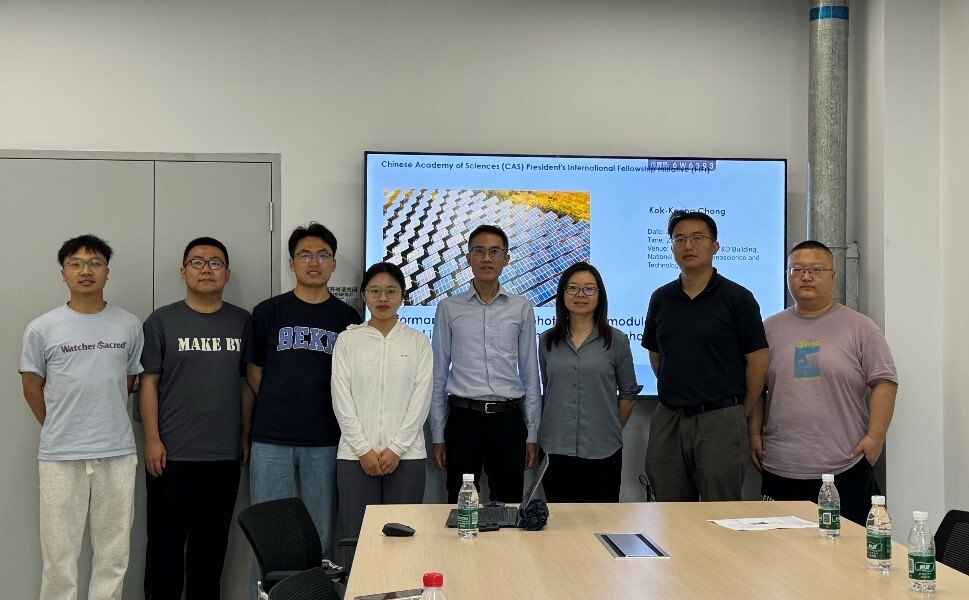
Photo: Group photo of Dr. Kok-Keong Chong, a PIFI Visiting Scientist, with his NCNST host, Prof. Huiqiong Zhou, and teammates.

