


I would like to begin by expressing my deepest gratitude to the CAS-PIFI program for this prestigious honor and award. Being selected as a visiting scientist (CAS-PIFI Fellow) has been an incredible opportunity that has allowed me to immerse myself in cutting-edge research at one of the world's leading institutions for nanoscience and technology. During my tenure as a CAS-PIFI Fellow, I had the extraordinary opportunity to immerse myself in the world of nanoscience at the National Centre for Nanoscience and Technology (NCNST) in Beijing, China. This prestigious institution is globally recognized for its groundbreaking research in nanoscience and nanotechnology, and being part of it was an experience that profoundly impacted my career and research trajectory.
From the moment I arrived at NCNST, I was struck by the sheer scale and sophistication of the research facilities. The center is a hub of innovation, equipped with state-of-the-art laboratories that house some of the most advanced technologies available in the field of nanoscience. These facilities are not just tools for research; they are gateways to discovery, enabling scientists to explore the fundamental properties of materials at the nanoscale with unparalleled precision. At NCNST, the atmosphere is one of relentless curiosity and pursuit of knowledge. The center attracts some of the brightest minds in the world, creating a melting pot of ideas and expertise. This environment fosters interdisciplinary collaboration, which is essential in the field of nanoscience, where the boundaries between physics, chemistry, biology, and engineering often blur.
One of the most significant aspects of my time at NCNST was the mentorship I received from Professor Zhiyong Tang. Professor Tang is a leading figure in the field of nanoscience, known for his pioneering work in the synthesis and application of nanomaterials. His guidance and insights were invaluable to my research on photocatalytic C-H activation, a process with the potential to revolutionize the field of sustainable chemistry by enabling more efficient and environmentally friendly chemical reactions. Under Professor Tang’s mentorship, I was able to delve deeply into the mechanisms of photocatalysis, exploring how light can be harnessed to drive chemical transformations that were previously thought to be impossible. This research not only expanded my understanding of the field but also opened new avenues for future exploration. Professor Tang’s approach to mentorship was both rigorous and supportive; he encouraged me to think critically and independently while providing the resources and guidance needed to overcome the inevitable challenges that arise in cutting-edge research.
The culture of collaboration at NCNST was another highlight of my experience. My labmates were incredibly friendly and supportive, creating a collegial environment where ideas could be freely exchanged, and everyone’s contributions were valued. This collaborative spirit was particularly evident in my interactions with Mr. Li Siyong, affectionately known as "This Young." His assistance was instrumental in helping me navigate both the technical and logistical aspects of my research, from mastering complex experimental techniques to understanding the nuances of working in a Chinese research environment. The support I received from my colleagues extended beyond the laboratory. They were always willing to share their expertise and offer advice, whether it was about optimizing an experiment or understanding the latest developments in nanoscience. This sense of community made my time at NCNST not just productive but also enjoyable. The friendships and professional relationships I built during this period are among the most valuable outcomes of my fellowship.
My research at NCNST focused on the photocatalytic activation of C-H bonds, a process that holds significant promise for the development of more sustainable chemical processes. C-H bonds are among the most abundant in organic molecules, but they are also notoriously difficult to activate selectively. Photocatalysis, which uses light to drive chemical reactions, offers a potentially elegant solution to this challenge, enabling the selective activation of C-H bonds under mild conditions. The research I conducted at NCNST involved the design and synthesis of novel photocatalysts that could efficiently activate C-H bonds in a variety of substrates. This work required not only a deep understanding of the principles of catalysis but also the ability to design experiments that could reveal the underlying mechanisms of the reactions. The state-of-the-art facilities at NCNST were crucial in this regard, allowing me to conduct detailed studies of the photocatalytic processes using advanced spectroscopic and analytical techniques. One of the most exciting aspects of this research was the potential for real-world applications. The ability to selectively activate C-H bonds could lead to the development of new, more efficient synthetic pathways for a wide range of chemicals, from pharmaceuticals to agrochemicals. This could have significant environmental benefits, reducing the need for harsh chemical reagents and lowering the energy requirements of industrial processes.
Beyond the research itself, my experience at NCNST was a catalyst for personal and professional growth. Working in a world-class research environment challenged me to push the boundaries of my knowledge and capabilities. I had to adapt to new ways of thinking and working, learning not only from my successes but also from the inevitable setbacks that are part of any ambitious research project. The international nature of the research community at NCNST also provided me with a broader perspective on the field of nanoscience. I had the opportunity to interact with scientists from around the world, each bringing their unique insights and experiences to the table. These interactions were invaluable in broadening my understanding of the global challenges and opportunities in nanoscience and technology.
Being part of Professor Tang’s group at NCNST was not just an academic opportunity; it was an honor. The group’s commitment to excellence, combined with its collaborative and supportive culture, made it an ideal environment for scientific discovery. The experience has had a lasting impact on my career, providing me with the knowledge, skills, and professional network needed to pursue my research goals with confidence.
In addition to the day-to-day research and collaboration, I was also fortunate to participate in the ChinaNano2023 international conference during my fellowship. This prestigious conference is one of the largest and most influential gatherings of nanoscience experts from around the world. Attending ChinaNano2023 was an eye-opening experience, offering me a unique platform to present my research, exchange ideas with leading scientists, and explore the latest advancements in the field. The conference provided numerous opportunities to meet like-minded professionals, build new connections, and discuss potential collaborations. These interactions have greatly expanded my professional network and will undoubtedly play a crucial role in shaping my future research endeavors.
As I reflect on my time at NCNST, I am filled with gratitude for the opportunities I have had and the people who have supported me along the way. The experience has not only enriched my understanding of nanoscience but has also reinforced my commitment to advancing the field through innovative research.
Looking forward, I am eager to build on the work I started at NCNST. The insights I gained into photocatalytic C-H activation have opened up new avenues for exploration, and I am excited to continue this research in collaboration with my colleagues at NCNST and beyond. The relationships I have built during my time in Beijing will undoubtedly play a crucial role in these future endeavors, providing a foundation of support and collaboration that will drive my research forward.
In conclusion, my experience as a CAS-PIFI Fellow at the National Centre for Nanoscience and Technology was transformative. It was an honor to work under the mentorship of Professor Zhiyong Tang, to conduct cutting-edge research in a world-class facility, and to be part of a vibrant and supportive research community. I leave NCNST not only with a sense of accomplishment but also with a renewed passion for scientific discovery and a deep appreciation for the power of collaboration in advancing knowledge.
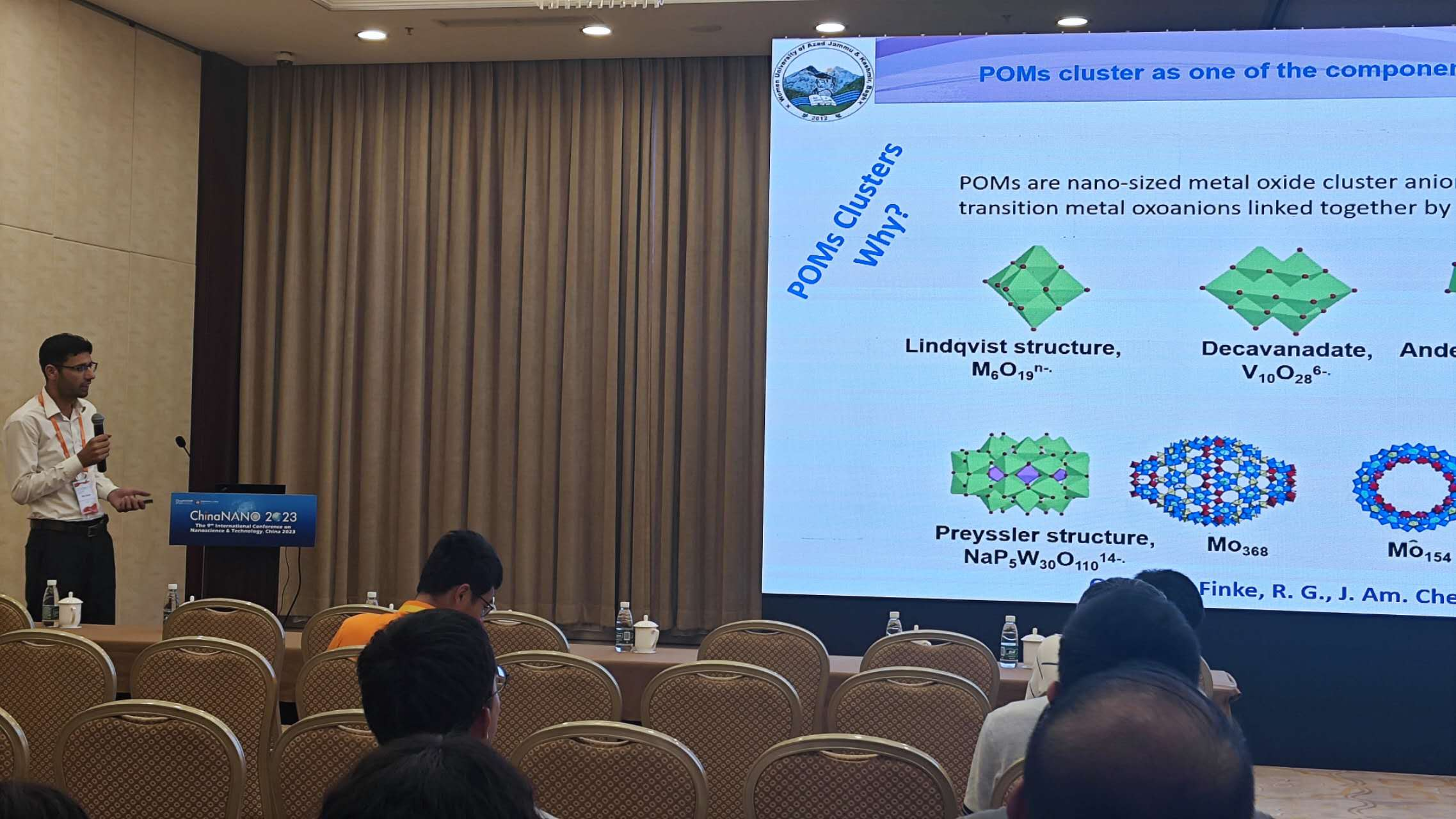
Photo: Dr. Bilal Akram, a PIFI Visiting Scientist, is delivering a talk about sub-nanometer assembly on the 9th International Conference on Nanoscience and Nanotechnology, China (ChinaNANO 2023) .

