


Organic solar cells (OSCs) stand out among next-generation photovoltaic technologies for their solution processability, flexibility, and semitransparency. But a stubborn bottleneck has limited their power conversion efficiency: the loss of open-circuit voltage, in which non-radiative recombination accounts for the dominant share.
Additive engineering is the field's standard tool for refining the blend film morphology, and it reliably boosts short-circuit current density and fill factor by promoting ordered molecular packing and moderate phase separation. The catch, as conventional wisdom holds, is that this very process enhances the delocalization of interfacial charge transfer (CT) states while lowering their energy, which aggravates non-radiative recombination and drags down the open-circuit voltage. Current gains, it seemed, must be paid for in voltage.
Reporting in Angewandte Chemie International Edition, a team led by Prof. ZHOU Huiqiong at the National Center for Nanoscience and Technology (NCNST), together with collaborators, now shows that this trade-off is not inevitable, and explains why.
Working with a model system built from the classic donor PM6 and a series of A-D-A'-D-A type non-fullerene acceptors, with 1-chloronaphthalene as the additive, the researchers suppressed photovoltage loss by more than 30 meV while preserving high charge generation and transport efficiency. Temperature-dependent optoelectronic measurements, transient absorption spectroscopy, morphology analysis, and molecular dynamics simulations converged on a clear physical picture: the additive elevates the dielectric constant of the blend film and reduces energy disorder, and at the same time modulates how acceptor molecules aggregate and pack. Together these effects inhibit the back charge transfer from free carriers to CT states, the core pathway through which non-radiative recombination drains voltage.
The mechanism proved universal across multiple A-D-A'-D-A acceptor systems bearing different side chains. In devices based on the D18:L8-BO system, the team reached a power conversion efficiency of 20.12%. More broadly, the study established a unified linear relationship: both the open-circuit voltage gain and the reduction of non-radiative recombination loss scale linearly with the increment of the blend's dielectric constant. This makes the dielectric constant a practical descriptor for predicting how much voltage loss a given additive can suppress, offering concrete guidance for the molecular design of future additives.
By turning a phenomenological processing trick into a physically grounded, quantifiable design rule, the work points a way toward organic solar cells that no longer have to choose between current and voltage.
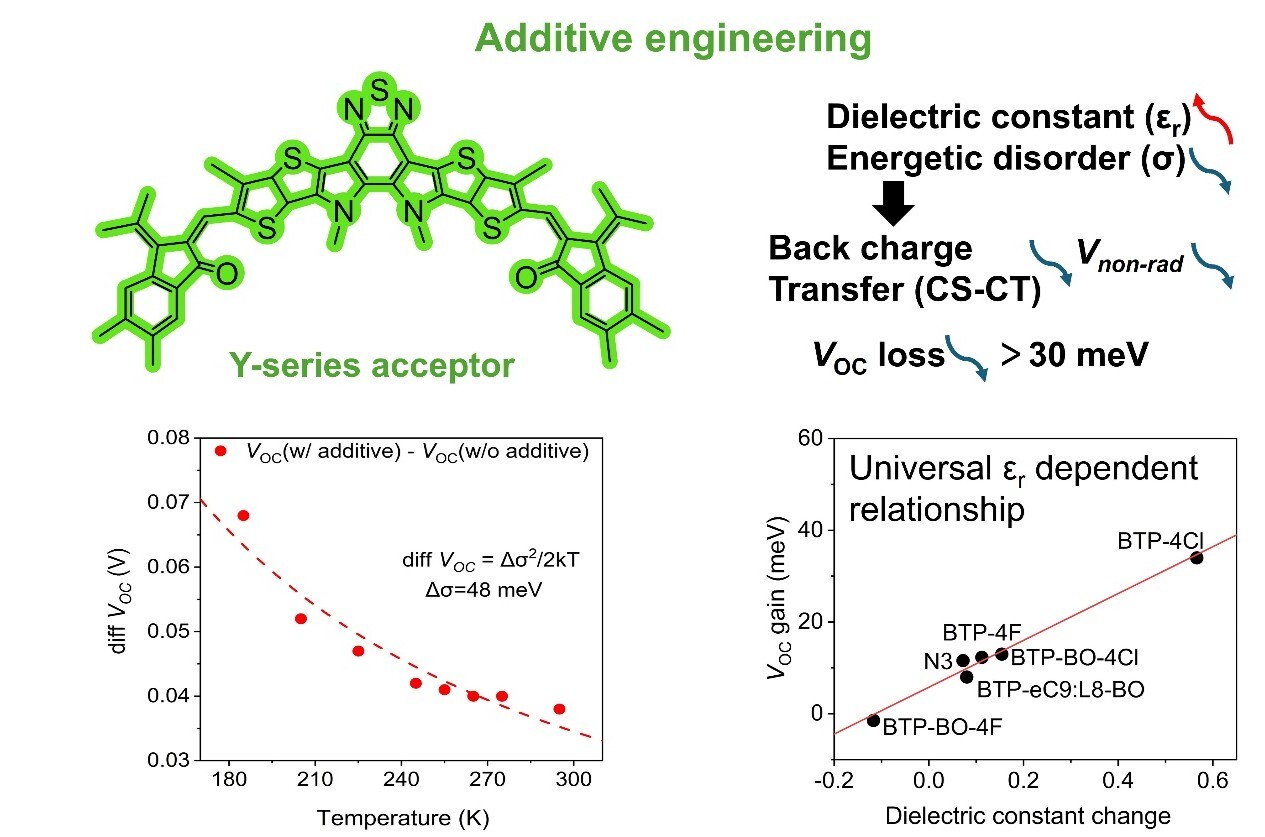
Schematic of how additive engineering suppresses photovoltage loss in organic solar cells by raising the blend's dielectric constant and inhibiting back charge transfer. (Image by LI et al.)
Contact:
Prof. ZHOU Huiqiong
National Center for Nanoscience and Technology
Email: zhouhq@nanoctr.cn

