


Ammonia is a cornerstone of global agriculture and a promising carrier for renewable energy storage. However, nearly all ammonia worldwide is produced via the Haber-Bosch process, which operates above 400°C and 200 atm, consuming about 2% of global energy and producing substantial carbon emissions. Finding a sustainable alternative under mild conditions has thus become a major scientific challenge in chemistry and energy.
A research team led by Prof. CHEN Lan and Prof. GE Guanglu from the National Center for Nanoscience and Technology (NCNST), Chinese Academy of Sciences has reported a catalyst-free nanobubble chemistry strategy for ammonia synthesis at room temperature and low pressure. By harnessing free radicals generated from the collapse of N2/H2 bulk nanobubbles, the team achieved nitrogen fixation with ~60% selectivity toward ammonia. EPR capture and DFT calculations showed that the chemical potential of H· radicals generated in situ during nanobubble collapse reaches ~2.3 eV, sufficient to directly supply the energy required for N≡N bond activation (energy barrier: 1.59 eV), thereby bypassing the high energy input and catalytic conditions required by traditional pyrolysis.
Nanobubble chemistry focuses chemical reactions driven by gas bubbles at the nanoscale (typically <1 μm in diameter). According to the Young-Laplace equation, a 100 nm bubble can hold an internal pressure of dozens of atmospheres. More importantly, nanobubbles possess a unique boundary layer and release abundant reactive free radicals during collapse, making them natural "microreactors" that can drive reactions otherwise requiring extreme conditions. Nanobubble chemistry offers value not only in providing transient localized high temperature and pressure but also in precisely delivering radical chemical potential, opening an entirely new activation pathway for high-energy-barrier reactions.
The study, proposing a new chemical reaction paradigm that leverages the high transient energy flow generated by nanobubble collapse in water to accomplish reactions difficult to achieve under conventional conditions at mild temperature and pressure, has been published in the Journal of the American Chemical Society.
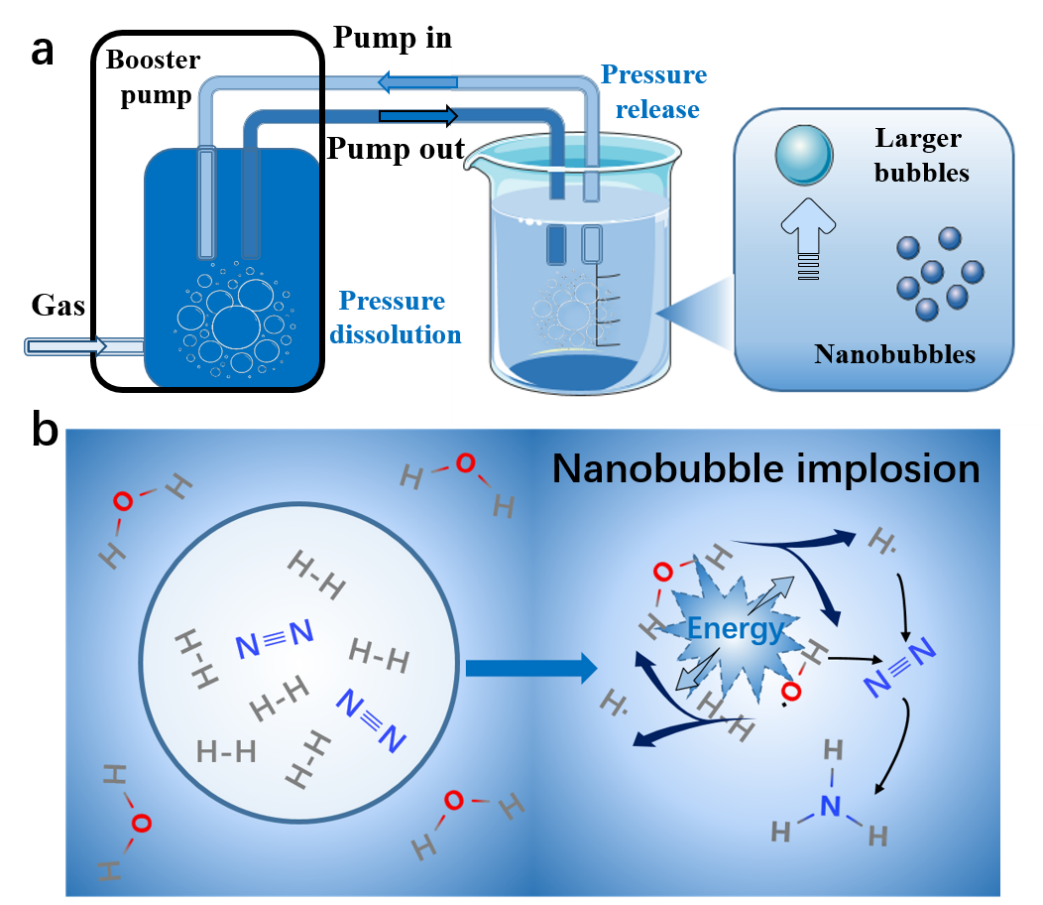
Scheme for nanobubble chemistry including both generation and implosion of the nanobubble in solution (Image from NCNST)
Contact:
Prof. CHEN Lan
National Center for Nanoscience and Technology
Email: chenlan@nanoctr.cn
Prof. GE Guanglu
National Center for Nanoscience and Technology
Email: gegl@nanoctr.cn

