


Recently, a research team led by Prof. Xiangnan Sun at the National Center for Nanoscience and Technology (NCNST), Chinese Academy of Sciences, in collaboration with Prof. Kun Zheng of Beijing University of Technology, has made a series of advances in high-performance molecular spintronic devices and their functional applications.
The research team focused on a key challenge in the field: the low efficiency and limited controllability of room-temperature spin transport efficiency in molecular spintronic devices, which severely restrict their potential for practical applications. To address this challenge, the team developed a novel spatial confinement strategy. Through solid-state nanostructure engineering of molecular semiconductors, the researchers substantially enhanced and effectively modulated room-temperature spin signals, and further demonstrated novel functional applications based on molecular spintronic devices. The related results have been published in Advanced Materials, Advanced Functional Materials, and Nano Today.
With the rapid development of artificial intelligence and big-data technologies, conventional electronic devices are facing growing challenges in terms of power consumption and information-processing efficiency. Spintronic devices, which exploit the spin degree of freedom of electrons for information transmission and processing, have therefore emerged as an important avenue toward next-generation information technologies. Molecular semiconductors are particularly promising for room-temperature spin applications owing to their highly tunable molecular structures and intrinsically long spin lifetimes at room temperature. Despite substantial progress over the past two decades in molecular design, interface engineering, and related approaches, the room-temperature spin transport efficiency of molecular devices has generally remained low, typically around 5%, while effective strategies for modulating spin transport are still lacking. These limitations have become major bottlenecks for realizing the full potential of molecular spintronic devices in functional applications.
To overcome these challenges, the research team moved beyond conventional approaches based primarily on molecular and interfacial engineering and introduced a spatial confinement strategy. By exploiting liquid–liquid phase separation in fullerene-derivative/polymer blends, the researchers transformed continuous bulk molecular semiconductor films into separated nanocolumn transport channels. This spatially confined architecture restricts the lateral diffusion of spin carriers and reduces the complexity of spin transport pathways, thereby substantially suppressing spin relaxation and enhancing room-temperature spin transport efficiency. By further tuning the polymer content and molecular weight, the researchers achieved precise control over the phase-separated nanostructures and established a clear structure–property relationship between the nanostructure and spin transport performance. Based on this approach, a record-high room-temperature spin transport efficiency of nearly 20% was achieved.
The researchers further demonstrated that vertically asymmetric solid-state nanostructures in molecular semiconductors can be employed to regulate the spin transport process, enabling pronounced bias-dependent asymmetric spin responses. Building on the highly efficient and controllable room-temperature spin signals, the team subsequently demonstrated functional applications of molecular spintronic devices in spin-information encryption and true random-number generation, extending molecular spintronics from high-performance spin transport toward controllable spin functionalities.
These studies demonstrate that solid-state nanostructure engineering represents a new dimension for regulating molecular spin transport, complementary to established strategies based on molecular design and interface engineering. The findings provide new opportunities for overcoming the bottleneck of room-temperature spin transport, achieving precise control of spin signals, and developing molecular spintronic devices for emerging applications such as spin logic, encrypted information storage, and random information processing.
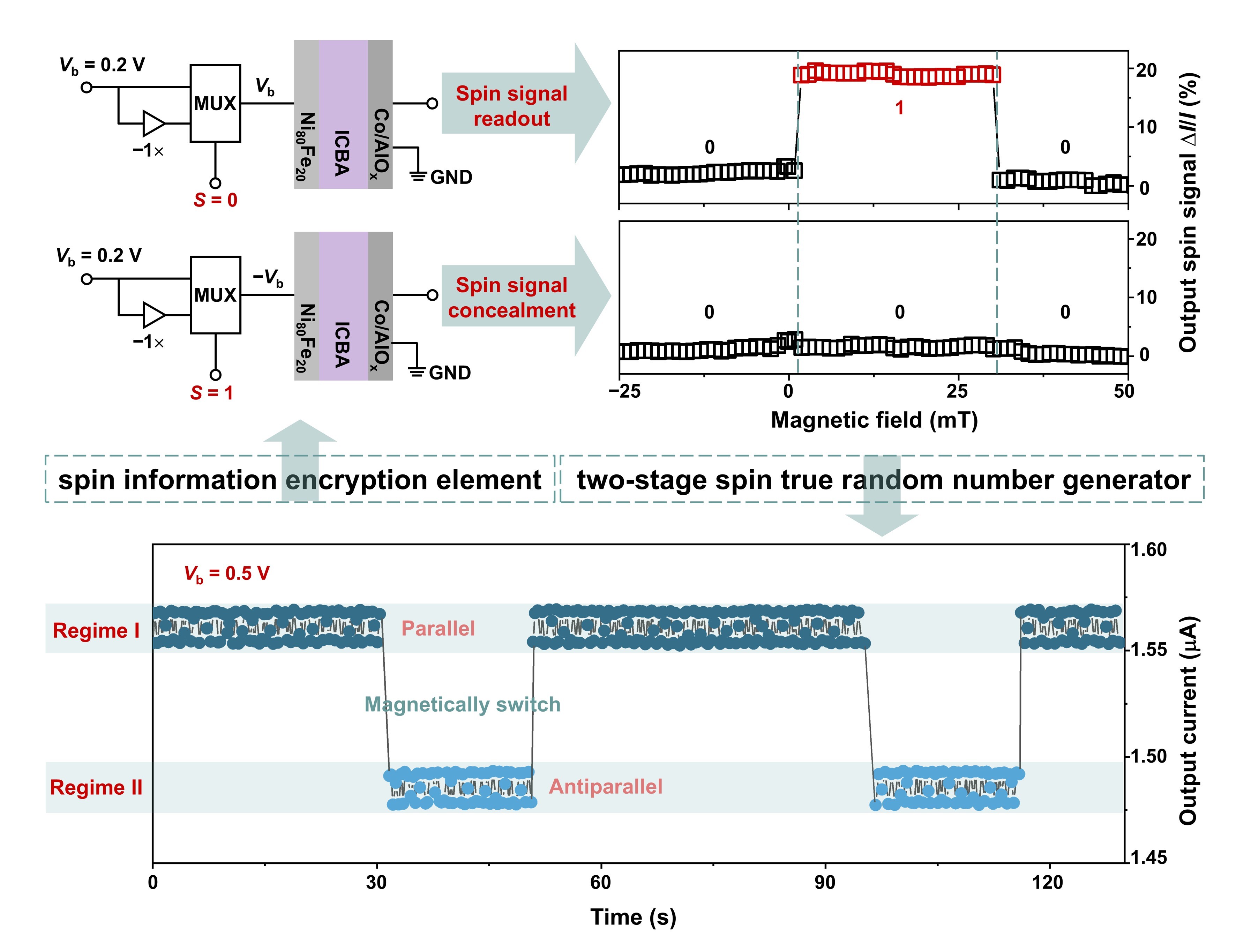
Novel spintronic functionalities enabled by molecular spin valves with phase-separated nanostructured transport channels for spin-information encryption and true random-number generation (Image from NCNST).
Contact:
Prof. SUN Xiangnan
National Center for Nanoscience and Technology
Email: sunxn@nanoctr.cn

