


Compared with singlet-state emission, materials based on triplet-state emission possess advantages such as long excited-state lifetimes (on the order of microseconds to seconds), large Stokes shifts, and high exciton utilization efficiency. They show broad application prospects in fields including anti-counterfeiting, information encryption, solar energy storage, and biological imaging. However, the transition between singlet and triplet states is a spin-forbidden process, which usually requires strong spin-orbit coupling or specially designed charge-transfer states to achieve efficient intersystem crossing (ISC). Organic-inorganic hybrid materials can synergistically enhance spin-orbit coupling by integrating the lone pairs of electrons of organic components, the heavy-atom effect of metals, and the rigid structure of inorganic frameworks. This significantly improves the ISC rate, suppresses non-radiative decay, and thereby realizes efficient radiative transitions between singlet and triplet excitons. Notably, this type of material can provide effective pathways for regulating the ISC process through diverse luminescence mechanisms. Although theoretically, customized regulation of the ISC process can be achieved through precise structural design, practical implementation still faces enormous challenges: the diversity of organic and inorganic components, complex formation mechanisms, and nearly infinite structural topological possibilities make it extremely difficult to precisely manipulate the ISC process at the atomic scale, imposing extremely high requirements for the fine control of material structures.
The modular architecture of layered hybrid superlattices (LHSLs) enables the atomic-scale integration of inorganic metallic atomic layers with tailored atomic arrangements and organic ligand layers with chemically tunable configurations. This structural flexibility provides a universal platform for systematically exploring the complex electronic and spin interactions between inorganic layers and organic components. The inherent rigidity of the inorganic framework suppresses the intramolecular vibrational modes of organic components, effectively minimizing non-radiative relaxation channels. Meanwhile, its periodic lattice serves as a spatially confined template, aligning organic molecules in specific directions and restricting their rotational and torsional motions. These mechanisms of spin-orbital hybridization, vibrational suppression, and topological control collectively enable targeted electronic structure engineering. Therefore, the controlled generation of excitonic states and precise manipulation of spin dynamics can achieve systematic regulation of ISC efficiency, demonstrating a hierarchical design strategy for functional hybrid materials.
Recently, a collaborative team led by Prof. GUO Lin from Beihang University and Prof. LIU Xinfeng from the National Center for Nanoscience and Technology, China (NCNST) published a research paper titled "Layered hybrid superlattices with a regulated intersystem crossing process" in Nature Synthesis. They developed a modular self-assembly strategy and successfully prepared superlattices composed of alternately stacked atomic-scale gold nanolayers and organic layers of 4-mercaptobenzamide derivatives. The design of this layered structure achieves directional hybridization between the d orbitals of transition metals and the delocalized electrons of organic molecules through controlled Au–π conjugation interactions, enhancing spin-orbit coupling and promoting rapid ISC from singlet to triplet states.
In this study, by constructing layered organic-inorganic hybrid superlattice materials, the adjustable electronic/atomic properties of inorganic metal layers are combined with the programmable chemical functions of organic ligand layers, realizing precise regulation of electronic states, exciton behaviors, and intersystem crossing processes. The team designed and prepared gold-based hybrid superlattices alternately assembled from atomically thick gold layers and 4-mercaptobenzamide derivative ligand layers, demonstrating a new method for precisely regulating the ISC process in confined structures. Through controlled Au–π conjugation interactions, the structure achieves directional hybridization between metal d orbitals and organic delocalized electrons. Femtosecond transient absorption spectroscopy shows that as the interlayer spacing decreases, the ISC time shortens from >2 ps to 0.26 ps, highlighting the promoting effect of structural confinement on ultrafast ISC. Variable-temperature photoluminescence spectroscopy further measured a singlet-triplet energy gap of approximately 20 meV, providing experimental evidence for the enhanced ISC mechanism. This research not only establishes a new class of hybrid superlattice material systems with customizable spin-orbit interactions but also realizes the regulation of fluorescence-phosphorescence dual-emission properties, laying an important foundation for the development of next-generation optoelectronic devices.
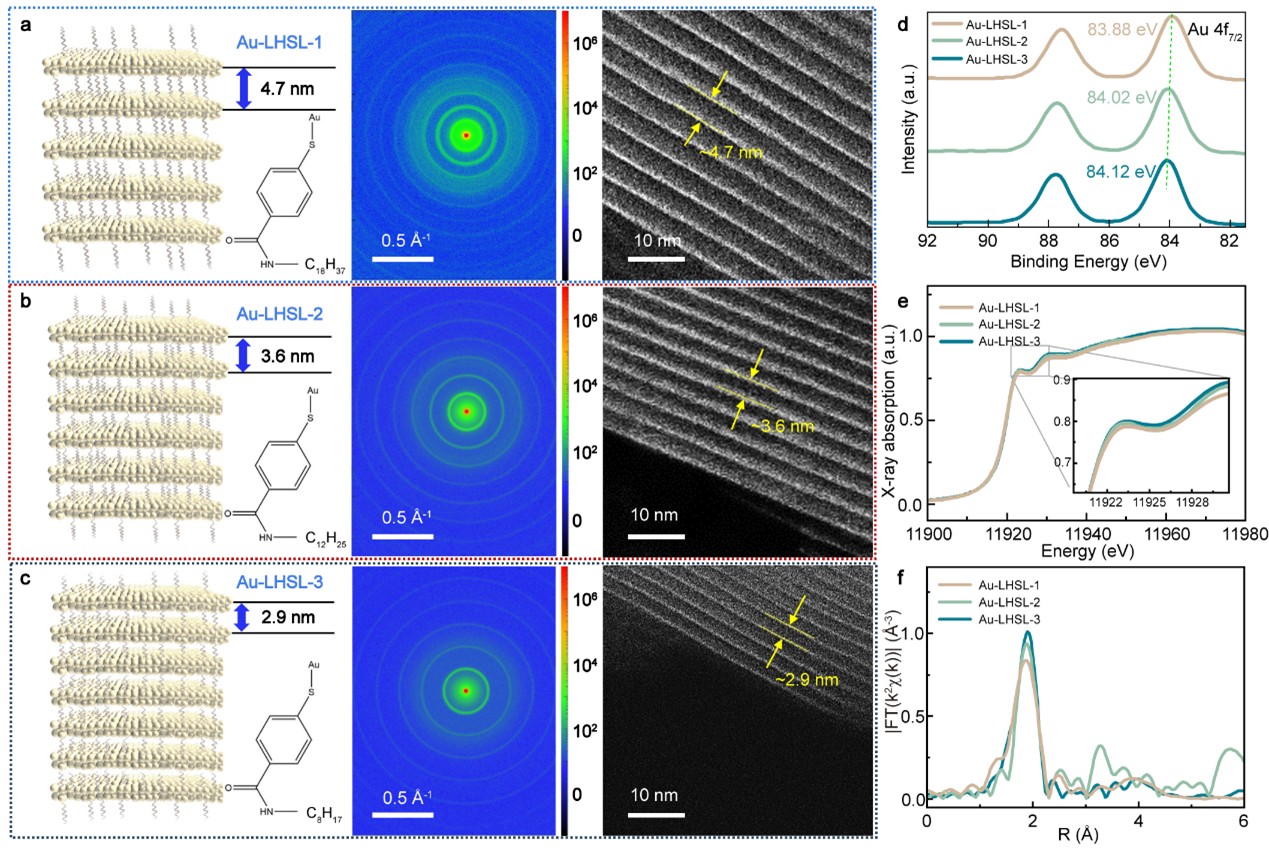
Figure 1. Structure characterization of various Au-LHSLs. a–c, Schematic diagram (left panel) of superlattice, 2D-SAXS images (middle panel), HAADF-STEM image (right panel) of Au-LHSL-1 (a), Au-LHSL-2 (b) and Au-LHSL-3 (c). d–f, XPS (d), XANES (e) and EXAFS (f) results of various superlattice structures.
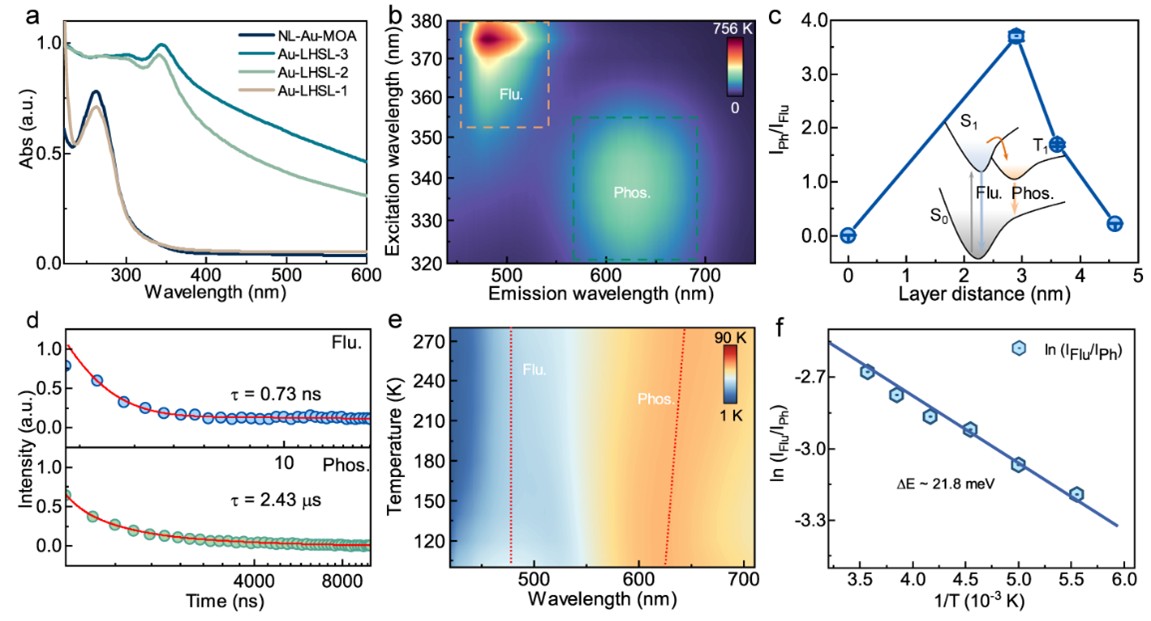
Figure 2. Luminescent properties of Au-LHSLs. a, Optical absorption spectra of amorphous Au-LHSLs and NL-Au-MOA. b, Excitation phosphorescence mapping spectrum of amorphous Au-LHSL-1. c, Phosphorescence and fluorescence intensity ratios as a function of layer distance. Inset: schematic of phosphorescent emission. d, Kinetic decay curves of amorphous Au-LHSL-1 probed at 490 nm and 620 nm. e, Temperature dependence of the emission spectra of amorphous Au-LHSL-3 pumped at 375 nm. f, Logarithm plot of phosphorescence and fluorescence intensity ratios as a function of temperature and the linear fit.
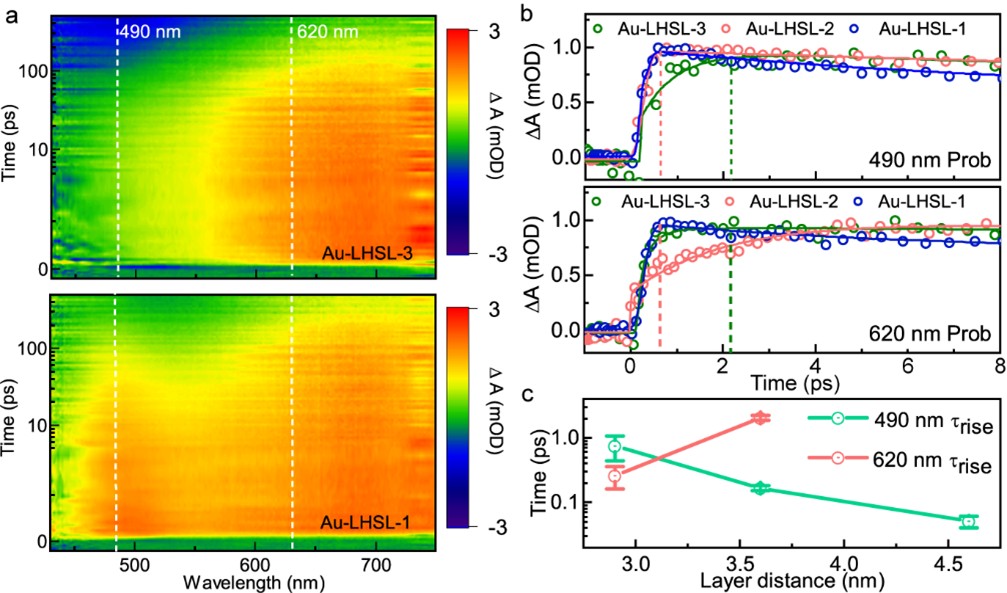
Figure 3. Ultrafast excited-state dynamics results of Au-LHSLs. a, Femtosecond TA data map of samples with different layer distances under 320-nm excitation. b, TA kinetic traces probed at 490 nm and 620 nm. c, Rising time of samples with different layer distances under 490-nm and 620-nm excitation. The times were obtained from femtosecond TA dynamics. A three-exponential fitting model was applied to describe the TA dynamics.
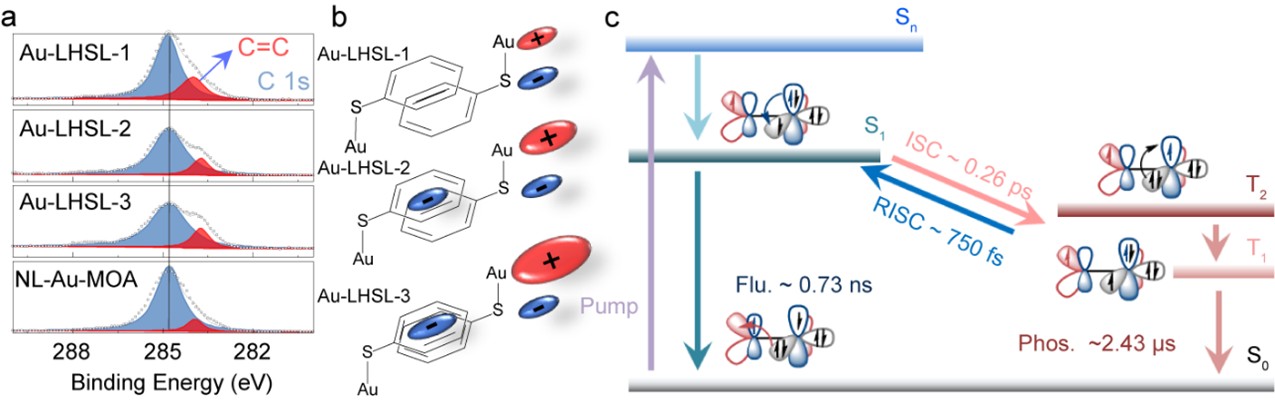
Figure 4. Charge redistribution induced by layered hybrid superlattice structure. a, XPS spectra of amorphous Au-LHSLs and NL-Au-MOA. b, Schematic of charge distribution and layer spacing. c, Schematic representation of phosphorescence emission mechanism in amorphous superstructures.
LIU Xinfeng
National Center for Nanoscience and Technology (NCNST)
E-mail: liuxf@nanoctr.cn

