


Researchers from National Center for Nanoscience and Technology, China (NCNST), and the collaborative institutes, co-led by Prof. WANG Hao et al., report a polymer-peptide-based nanomedicine that in situ reprograms tumor-immune interactions and strengthens checkpoint therapy in a series of colorectal cancer mouse model. The findings were published in Nature Nanotechnology, titling "Nanorobots Hold PD-L1 and Break Membrane of Colorectal Cancer Cells for Immunotherapy".
Colorectal cancer (CRC) is dominated by proficient mismatch repair (pMMR) "cold" tumors that exclude immune cells and respond poorly to PD-1/PD-L1 blockade.
To "heat up" pMMR tumors, chemotherapy, radiotherapy, and photothermal therapy are able to induce immunogenic cell death (ICD) to sensitize tumors to immune checkpoint inhibitors (ICIs), but non-specific biodistribution frequently brings serious adverse effects, such as myelosuppression, diarrhea, immune-related events.
The team designed nanomedicine to first bind PD-L1 on cancer cells, then, at mildly acidic pH typical of the tumor microenvironment (TME), shape-shift in situ from nanoparticles into nanofibers on the cell surface. This dynamic transformation physically perturbs membranes and triggers ICD, releasing "danger signals" that recruit and activate immune cells, while simultaneously relieving PD-1/PD-L1 suppression.
In multiple CRC mouse models, nanomedicine achieved sustained tumor retention (>120 h), increased intratumoral CD8⁺ T-cell infiltration, and produced stronger antitumor effects than standard regimens, with favorable biocompatibility. Mechanistic assays showed membrane disruption and hallmark ICD signals. It was found that the transformation process of in situ formation of fibers, not static fibers, drives efficacy.
This preclinical study suggests a generalizable polymer-peptide nanomedicine to turn "cold" tumors "hot". Next steps include pharmacokinetics and long-term safety profiling, and evaluation across additional solid tumor models to pave the way for clinical translation.
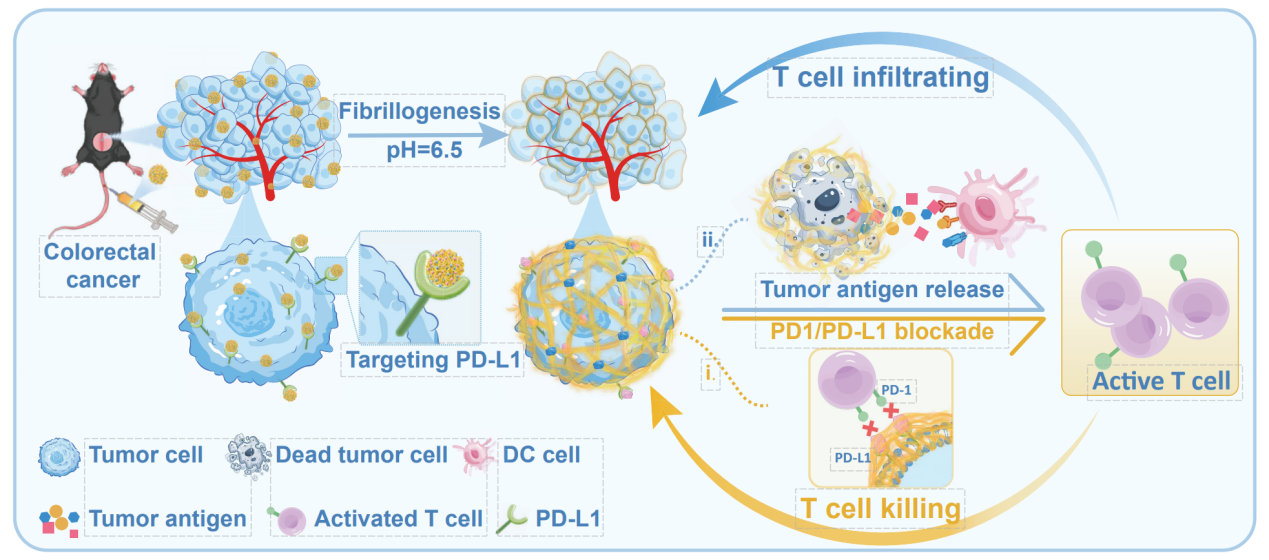
Schematic diagram: The mechanism of nanomedicine heating up the cold colorectal tumors (Image by WANG Hao et al)
Contact: WANG Hao
National Center for Nanoscience and Technology (NCNST)
E-mail: wanghao@nanoctr.cn

