


Second-harmonic generation (SHG), form the basis for core photonic functionalities including frequency conversion and signal modulation. However, in materials with centrosymmetric structures, the intrinsic second-order nonlinear optical response is typically forbidden at room temperature due to the presence of spatial inversion symmetry. This greatly limits the application of such materials in integrated nonlinear photonic devices.
Two-dimensional van der Waals antiferromagnetic material CrSBr has emerged as a forefront platform for spintronics and magneto-optics research due to its relatively high transition temperature (Néel temperature TN ~ 136 K), strong in-plane anisotropy, and rich magneto-optical and electronic properties. However, its SHG capability remains significantly limited in the paramagnetic state, leading to an extremely weak or even absent intrinsic SHG response above the Néel temperature. This greatly hinders its practical application and development in room-temperature, miniaturized, low-power nonlinear photonic devices.
Recently, the research team has made a breakthrough in addressing this key challenge. In this work, we have presented the first experimental demonstration of robust second-harmonic generation (SHG) at ambient temperature in centrosymmetric magnetic CrSBr through sophisticated crystal structure engineering. Most significantly, this engineered platform uniquely enables simultaneous probing of both crystallographic architecture (via i-type SHG) and magnetic ordering (via c-type SHG) within the same CrSBr flakes, substantially amplifying the overall SHG emission intensity.
The team innovatively integrated CrSBr flakes with aligned silver nanowires. The silver nanowires not only provide plasmonic near-field enhancement but also apply controllable nanoscale uniaxial strain at the contact regions. This strain drives a persistent structural phase transition in the material from an orthorhombic system (D2h point group) to a monoclinic system (Cs point group), thereby inducing local lattice symmetry breaking in CrSBr and realizing lattice reconfiguration at the microscopic scale. By altering the alignment direction of the silver nanowires (i.e., the strain axis), the material's second-order nonlinear susceptibility was further effectively modulated.
Additionally, temperature-dependent SHG characterization revealed that, upon entering the antiferromagnetic state, CrSBr maintains structural symmetry breaking (Cs point group) in the strained regions below the Néel temperature. At this point, the i-type SHG induced by strain-driven lattice symmetry breaking coherently superimposes with the c-type SHG arising from magnetic order, leading to a significant increase in the overall SHG signal intensity. This dual-mechanism approach reveals subtle structural symmetries that conventional characterization techniques cannot readily access, providing unprecedented insights into material properties at the nanoscale. The coherent interplay between these complementary SHG mechanisms establishes a powerful new paradigm for investigating nonlinear magneto-optical phenomena in devices operating under ambient conditions.
This work demonstrates the first activation of strong second-order nonlinear optical response in a centrosymmetric magnetic material at room temperature without external fields. By applying symmetry engineering we developed a functional device application, which opens transformative pathways toward harnessing the untapped potential of centrosymmetric magnetic materials for next-generation nonlinear optical technologies.
The related findings have been published in Nano Letters under the title "Second-Harmonic Generation by Reconfigurable Lattice Engineering in Centrosymmetric Magnetic CrSBr".
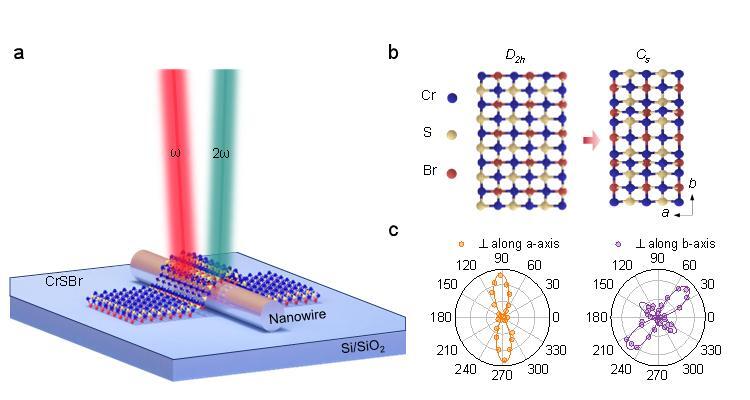
Figure 1. Second-harmonic generation response induced by lattice reconstruction via integration of 2D magnetic material CrSBr with silver nanowires (Image by LIU Xinfeng et al)
Contact: LIU Xinfeng
National Center for Nanoscience and Technology (NCNST)
E-mail: liuxf@nanoctr.cn

