


The selective epoxidation of alkenes is a crucial step in producing high-value fine chemicals and pharmaceutical intermediates. Although cerium dioxide (CeO₂) has been widely studied in catalysis, its application in complex selective oxidation reactions is often limited by the immense difficulty in precisely modulating its defect structures and local microenvironments.
Recently, a research team led by Prof. LI Guodong from the National Center for Nanoscience and Technology (NCNST) published a new study in Advanced Materials. The team proposed an innovative strategy to successfully achieve precise modulation of the dynamic coordination and microenvironment of defective cerium dual sites on Ce₆-oxo clusters within a cerium terephthalate metal-organic framework (UiO-66).
In this study, the researchers ingeniously designed a unique dual-site structure where each cerium site features one coordinative vacancy. This tailored local microenvironment not only facilitates the effective adsorption of reaction substrates but also enables the dynamic coordination of intermediates during the catalytic cycle through strong synergistic interactions between the dual sites.
This dynamic evolutionary process fundamentally alters the reaction kinetics. Both experimental results and theoretical calculations demonstrate that this dual-site catalytic system exhibits outstanding performance in alkene epoxidation, achieving a remarkable 99% selectivity for styrene epoxidation, which significantly outperforms traditional single-site catalytic materials.
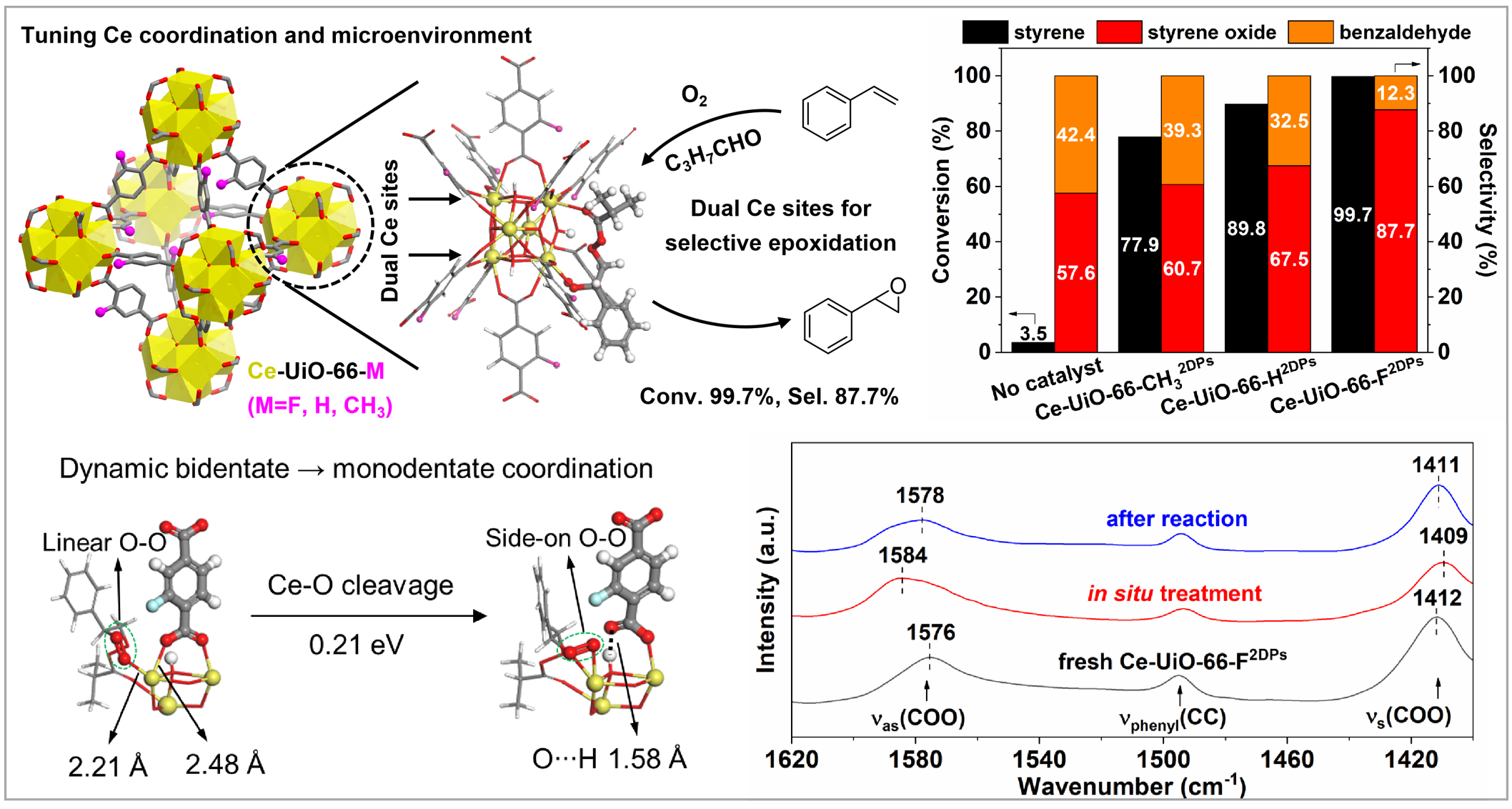
This work not only overcomes the technical bottlenecks of traditional cerium-based materials in microenvironment modulation but also provides a new theoretical framework and a highly feasible design paradigm for developing highly efficient dual-site catalysts with dynamic responsive characteristics.

