


To address the critical challenge of uncontrolled hemorrhage, particularly in patients undergoing antiplatelet therapy or suffering from coagulopathies, where traditional hemostatic materials often fail, the research team led by Professors Suping Li and Guangjun Nie from the National Center for Nanoscience and Technology, China (NCNST), in collaboration with Director Yaqi Zhai from the First Medical Center of the Chinese PLA General Hospital and Prof. Yan-Zhong Chang from Hebei Normal University, developed an "apoptotic reprogramming" strategy. The findings, titled "Reprogrammed apoptotic platelets drive rapid hemostasis through phosphatidylserine and prostaglandin E2 signaling in preclinical models", were published online in Science Translational Medicine.
This apoptotic reprogramming approach led to the development of hPPL, a procoagulant platelet derivative with high exposure of phosphatidylserine (PS). Mechanistic studies revealed that hPPL not only accelerates thrombin generation through high-density surface PS but also specifically activates the PTGES/PGE2/EP3 signaling pathway. This dual action effectively compensates for coagulation defects induced by antiplatelet drugs by recruiting and activating impaired endogenous platelets and the broader coagulation system.
The efficacy of hPPL was validated across various severe bleeding models in mice, rats, and Bama pigs, demonstrating superior performance in complex clinical scenarios. Under the promotion of Prof. Yuliang Zhao, Member of the Chinese Academy of Sciences, the material has entered multicenter investigator-initiated trials (IITs) at the Hospitals 301 and 304. It has already achieved rapid, safe hemostasis in several endoscopic polypectomy cases, significantly improving surgical visualization and success rates. This work not only advances the fundamental understanding of physiological hemostasis but also provides a novel theoretical framework and translational paradigm for high-performance bio-inspired hemostatic agents.
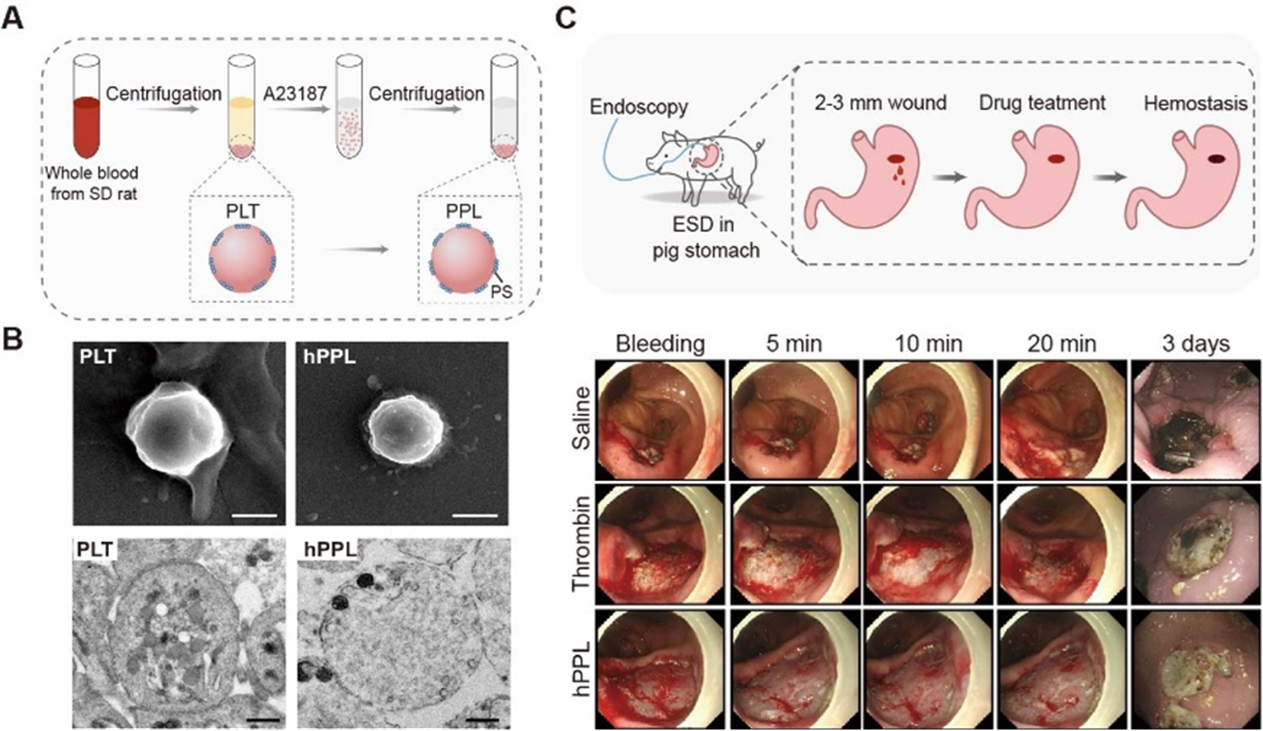
Schematic Diagram: Fabrication, characterization, and mechanisms of action of novel hemostatic materials (hPPL) (Image by SONG Shuailun et al)
Contact: LI Suping
National Center for Nanoscience and Technology (NCNST)
E-mail: lisuping@nanoctr.cn

