


Three-dimensional (3D) displays offer immersive visual experiences with immense potential across entertainment, education, virtual prototyping, and medical imaging. However, current polarized 3D display technologies rely primarily on linearly polarized multiplexing, which severely restricts the viewing angle, causes significant brightness loss (often over 50%), and reduces image contrast due to screen reflection. These limitations frequently lead to visual fatigue and viewer discomfort. Circularly polarized light-emitting diodes (CP-LEDs) are highly anticipated to resolve these issues by directly emitting high-purity circularly polarized light with low power consumption and wider viewing angles. Despite this potential, the simultaneous enhancement of external quantum efficiency (EQE) and the electroluminescence dissymmetry factor (gEL) has remained a critical challenge in the field. This is primarily due to self-depolarization caused by metal electrode reflection when using traditional chiral material-based emissive layers (EMLs).
Recently, a research team led by Prof. TANG Zhiyong and Prof. LIU Yaling from the National Center for Nanoscience and Technology (NCNST) published a breakthrough study titled "Electrically programmable circularly polarized 3D display" in Nature Photonics. Diverging from conventional strategies that rely on synthesizing complex chiral materials, the researchers introduced an innovative device architecture that spatially decouples photon polarization and spin. The team utilized super-aligned achiral inorganic nanorod/nanowire (NR/NW) co-assemblies as the EML to directly generate linearly polarized luminescence. Simultaneously, they integrated in situ inorganic nanowire assembled films to function as a quarter-wave plate (QWP), which efficiently converts the linearly polarized light into circularly polarized light.
By precisely regulating the composition of the inorganic nanorods and the phase shift of the linearly polarized luminescence, the engineered CP-LEDs demonstrated outstanding performance across blue, green, and red wavelengths. Notably, the red CP-LEDs achieved an exceptional gEL of 1.54 alongside an EQE of 6.1%, positioning the device among the highest-performing CP-LEDs in this spectral window globally.
To demonstrate practical viability, the researchers constructed a series of electrically programmable display panels utilizing 8×8 orthogonal CP-LED pixel matrices. This display panel prototype allows the brightness difference between left and right circularly polarized electroluminescence to be clearly distinguished by the naked eye when viewed through circular polarizers. The device can be programmed to display stereoscopic patterns, such as "NCNST," featuring high electroluminescence purity, a wide color gamut, and an excellent anti-glare effect due to the aligned nanowire structures effectively mitigating specular reflection.
This progress establishes a highly robust and scalable platform for achieving high-fidelity, glasses-assisted immersive 3D viewing, marking a crucial step toward the commercialization of CP-LED technologies in next-generation personalized displays.
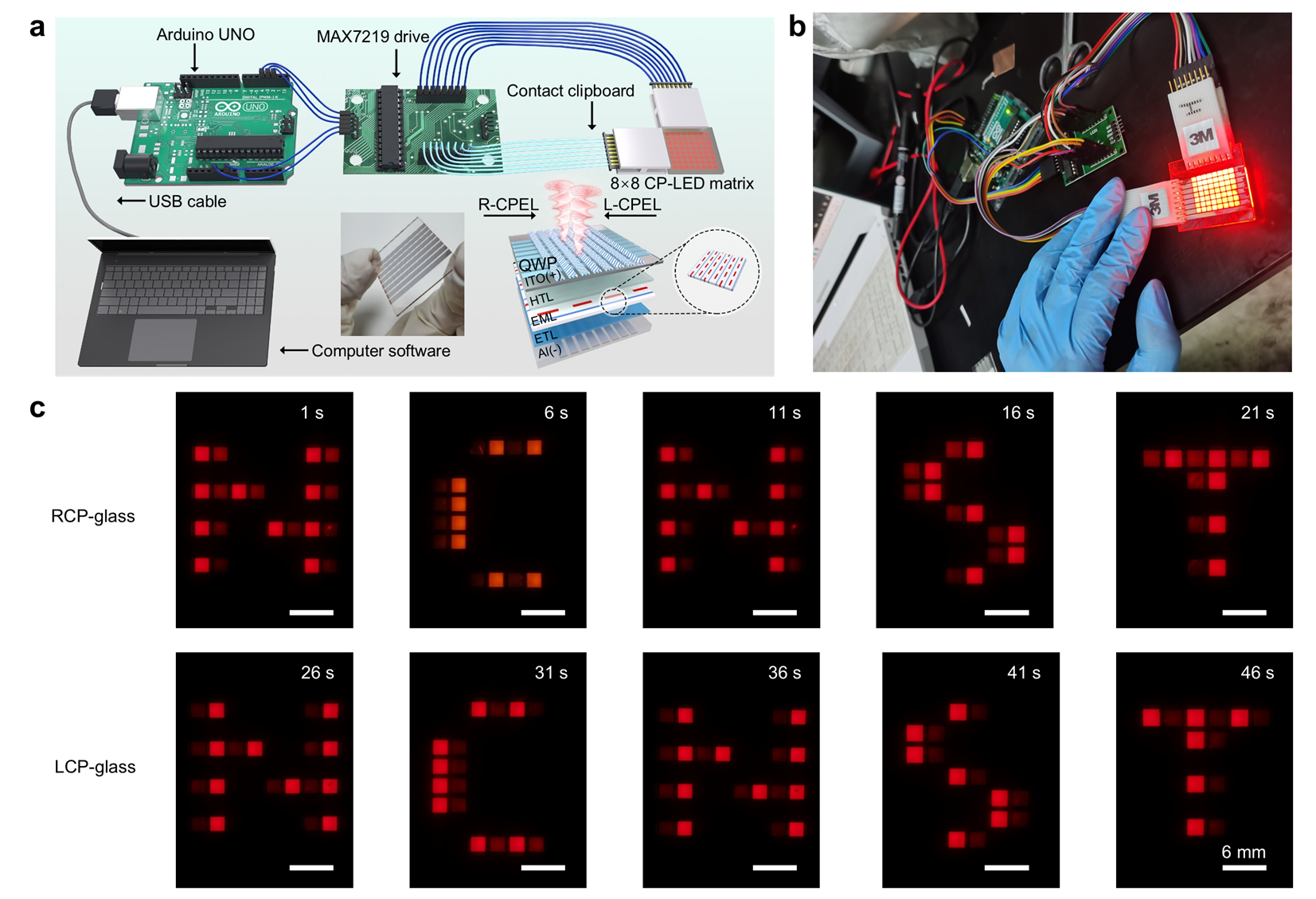
Schematic diagram of electricallyprogrammable 8×8 matrix systemand opticalphotograph of an 8×8matrixcomposed of 64 CP-LEDs
Contact: LIU Yaling
National Center for Nanoscience and Technology (NCNST)
E-mail: liuyl@nanoctr.cn

