


Urea is a pervasive nitrogenous pollutant that must be effectively eliminated from wastewater to prevent severe ecological damage, such as eutrophication. While conventional biological remediation strategies, such as the Anammox process, convert urea to innocuous nitrogen gas, they irrecoverably dissipate urea's substantial chemical energy as low-grade heat or microbial biomass. Electrochemical urea oxidation reaction (UOR) presents a highly promising alternative, offering a dual opportunity for wastewater purification and renewable hydrogen fuel generation. However, the efficiency of UOR has historically been hindered by sluggish kinetics, complex six-electron transfer dynamics, and the excessive energy demands of traditional nickel-based electrocatalysts.
Recently published in Nature Communications, a collaborative research team led by Prof. ZHAO Shenlong from the National Center for Nanoscience and Technology, China (NCNST) and Prof. YAO Hong from Beijing Jiaotong University engineered an integrated UOR-MD system that synergistically couples entropy-stabilized electrocatalysis with selective membrane separation.
At the core of this system is a newly developed medium-entropy metal-organic framework (ME-MOF). By partially substituting nickel sites with manganese, iron, cobalt, and bismuth atoms, the team utilized entropy-engineering principles to simultaneously stabilize the framework and create powerful electronic synergy among the different metal centers. This unique structural design optimizes the adsorption energetics for UOR intermediates and suppresses metal leaching. Consequently, the ME-MOF electrocatalyst delivers outstanding performance, requiring a low potential of only 1.36 V versus the reversible hydrogen electrode (RHE) to achieve an industrially relevant current density of 100 mA cm−2.
Beyond superior catalytic activity, the practical application of this technology was demonstrated by coupling the UOR module with a membrane distillation (MD) unit. This closed-loop electrothermal platform successfully removed 99.7% of urea from concentrated wastewater streams. During an impressive 1,000-hour dual-electrode stability test at 1 A, the system continuously produced high-purity water with an ammonia nitrogen concentration below 35 mg L−1, strictly adhering to U.S. EPA discharge standards. Furthermore, the MD module facilitated the concurrent recovery of the potassium hydroxide (KOH) electrolyte, establishing a synchronous resource circularity.
The implementation of this integrated system represents a paradigm shift from conventional wastewater treatment to profitable resource valorization. Comprehensive techno-economic analysis (TEA) revealed a decisive economic advantage: the UOR-MD system yields a net profit of $2.9 per cubic meter of treated wastewater, primarily offset by the production of high-purity green hydrogen. In stark contrast, conventional Anammox processes incur a net loss of $0.63 per cubic meter under similar conditions. Supported by a life cycle assessment (LCA) indicating improved environmental performance across multiple key indicators, this UOR-MD platform provides a highly scalable, economically viable, and sustainable pathway for next-generation wastewater valorization.
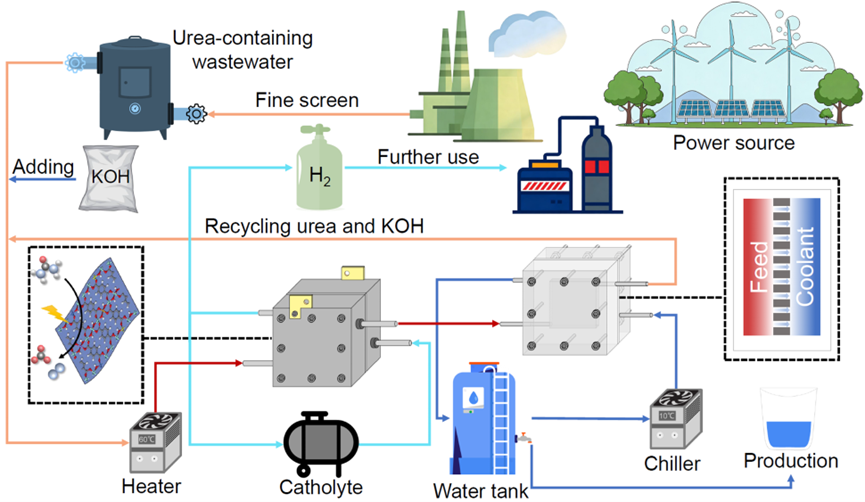
Schematic Diagram: Medium-entropy MOF-integrated Catalytic Distillation System (Image by ZHANG Songlin et al)
Contact: ZHAO Shenlong
National Center for Nanoscience and Technology (NCNST)
E-mail: zhaosl@nanoctr.cn

