


Recently, Shenlong Zhao's group at the National Center for Nanoscience and Technology has made important progress in the structural design and mechanistic investigation of catalysts for electrochemical CO2 reduction to ethylene. The related findings have been published consecutively in internationally renowned journals, including Angewandte Chemie International Edition (Angew. Chem. Int. Ed., 2026, e7848056) and Advanced Functional Materials (Adv. Funct. Mater., 2026, e76043).
Against the backdrop of China's "dual-carbon" strategy, the conversion of CO2 into high-value-added chemicals represents an important technological pathway for carbon resource recycling and low-carbon chemical manufacturing. Ethylene is one of the most important bulk chemicals in the modern chemical industry and is widely used in the production of polymers, fibers, and various fine chemicals. At present, industrial ethylene production mainly relies on high-temperature steam cracking of fossil hydrocarbons, a process characterized by high energy consumption and substantial carbon emissions. In contrast, the electrocatalytic reduction of CO2 to ethylene driven by renewable electricity offers a promising route to integrating CO2 resource utilization with green chemical production. However, CO2 electroreduction to ethylene involves complex proton-coupled electron transfer, multi-carbon coupling, and the competing hydrogen evolution reaction (HER). Therefore, the precise regulation of the dynamic reconstruction behavior of copper-based catalysts under reaction conditions, as well as the adsorption configurations of key intermediates on catalyst surfaces, remains a critical challenge for improving ethylene selectivity and operational stability.
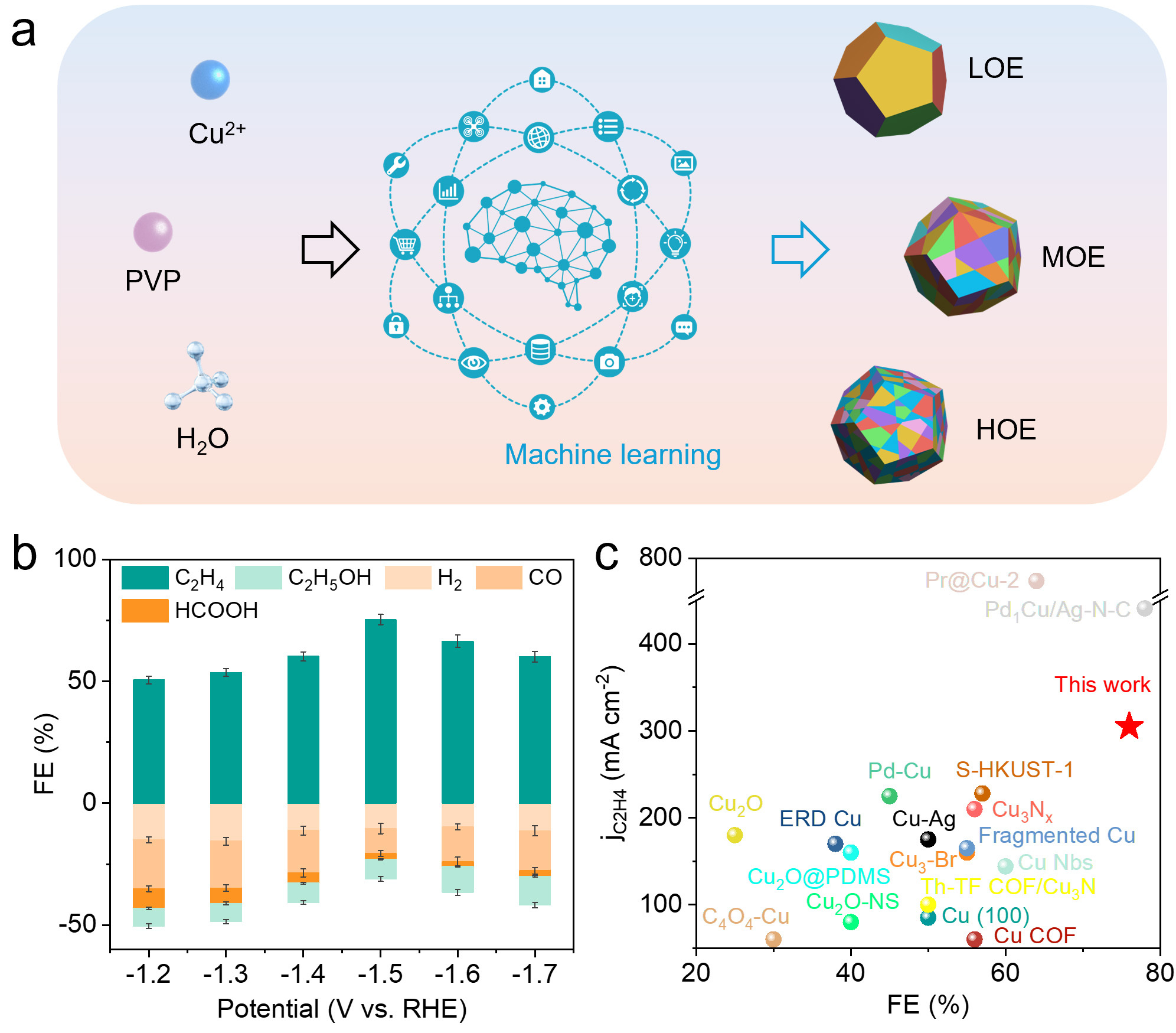
To address these challenges, Shenlong Zhao's group, in collaboration with the CHN Energy Low-Carbon Clean Energy Research Institute and University of Delaware, proposed a crystal-orientation entropy regulation strategy. By integrating machine-learning screening with controllable synthetic processes, the team constructed Cu2O catalysts with low, medium, and high orientation entropy. Mechanistic studies revealed that medium orientation entropy induces the formation of nearly eight-coordinated Cu0.4+-derived copper active sites during the reaction. These active sites optimize the kinetic balance between C–C coupling and hydrogenation reactions and promote the formation of the key *CO–*COH intermediate, thereby enabling efficient CO2 electroreduction to ethylene. The catalyst achieved an ethylene Faradaic efficiency of 75% at a current density of 400 mA cm-2 and maintained stable operation for more than 80 h. Preliminary techno-economic analysis and life-cycle assessment further indicated that this medium-entropy Cu2O-based CO2 electrocatalytic system possesses potential economic and environmental advantages over conventional ethylene production routes. The work, entitled "Orientation-Entropy-Mediated Derivative Cu Sites for Selective CO2 Electroreduction to Ethylene" was published in Angewandte Chemie International Edition.
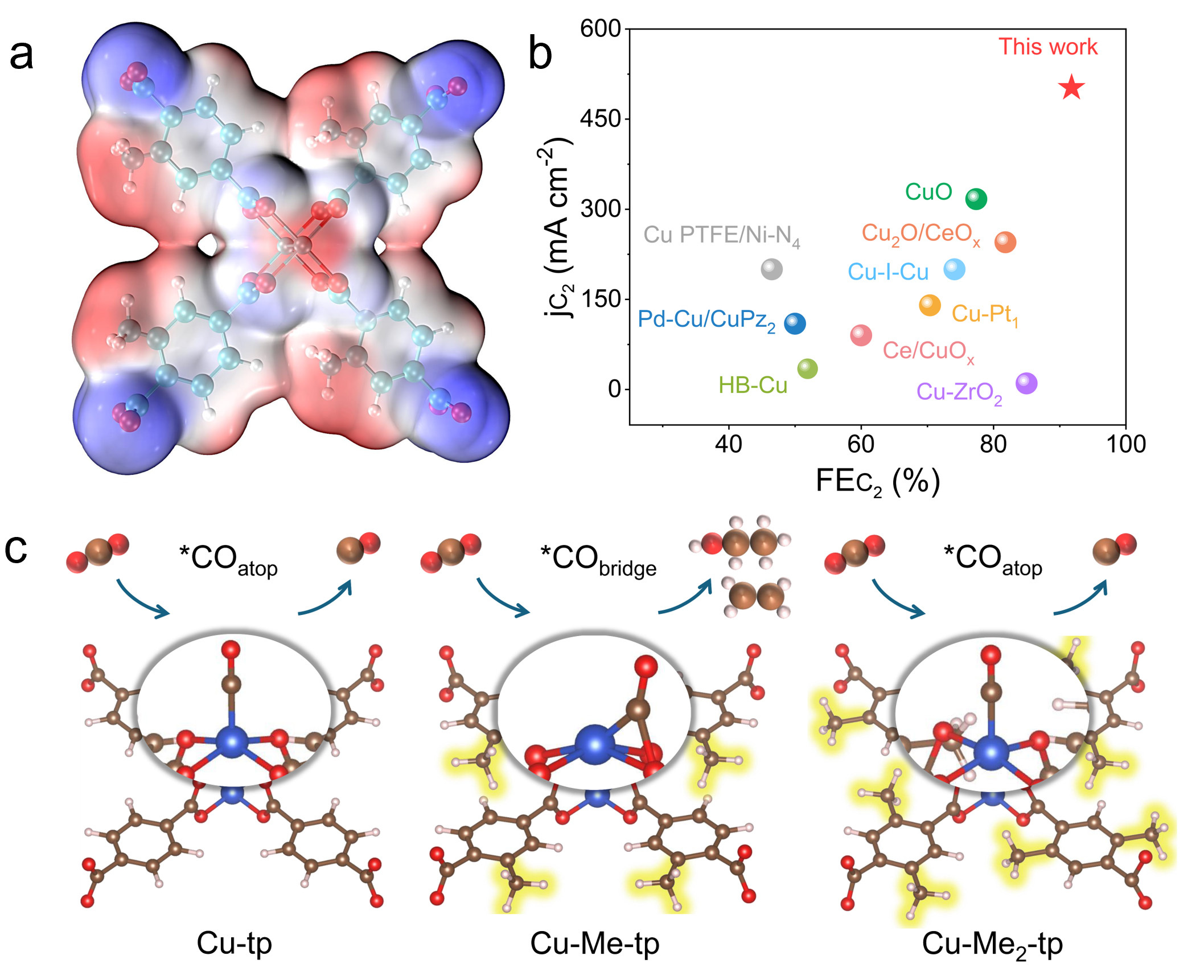
In parallel, the research group proposed a structural asymmetry regulation strategy based on metal–organic framework systems, enabling precise modulation of the adsorption configuration of carbon–oxygen intermediates on Cu sites. In situ spectroscopic characterization and theoretical calculations demonstrated that the asymmetric structure induces local electronic anisotropy at Cu sites, causing the *CO adsorption mode to shift from a atop configuration to a bridge configuration. This substantially lowers the energy barriers for C–C coupling and C₂ product desorption. As a result, a C2 product Faradaic efficiency of 93.1% was achieved at a current density of 540 mA cm-2, with continuous stable operation for more than 100 h. The related work, entitled "Structural Asymmetric Regulation in Metal-Organic Frameworks for Efficient Electrocatalytic CO2 to C2 Products" was published in Advanced Functional Materials.
These studies were supported by the National Key Research and Development Program of China, the National Natural Science Foundation of China, the Beijing Natural Science Foundation.

