


Recently, the research group led by Prof. ZHOU Huiqiong from the National Center for Nanoscience and Technology (NCNST) has achieved significant progress in the development of hole-transporting materials and interfacial regulation mechanisms for organic solar cells (OSCs). The corresponding achievement was published in Angewandte Chemie International Edition under the title "Topology-Engineered Coordination Polymers for Enhanced Hole Transport in Organic Solar Cells" .
Organic solar cells have emerged as a critical development direction for next-generation photovoltaic technologies due to their advantages of flexibility, light weight, and solution processability. However, compared with the rapid iteration of active layer materials, the development of hole-transporting materials has lagged behind. The traditional poly(3,4-ethylenedioxythiophene):polystyrene sulfonate (PEDOT:PSS) remains the most widely used hole-transporting material to date. Nevertheless, such materials face bottlenecks including poor stacking morphology, low vertical charge mobility, and energy level mismatch, which have become one of the key factors limiting breakthroughs in device efficiency and stability. There is an urgent need to develop new materials with precisely controllable structures and excellent transport properties.
Prof. Huiqiong Zhou's research group has long been dedicated to the interface regulation of hole-transporting materials for organic solar cells and has carried out a series of pioneering studies in this field. By introducing tungsten oxide nanoparticles to improve the interface properties of PEDOT:PSS hole-transporting layers, the team achieved a fill factor (FF) of 80% in organic non-fullerene solar cells (Adv. Mater., 2018, 30, 1801801). They further clarified the relationship between active layer stacking orientation, hole-transporting interface properties, and device performance (Adv. Mater., 2019, 31, 1806921), and subsequently elucidated the mechanism by which hole-transporting interlayer properties regulate device performance at the nanoscale (Joule, 2021, 5, 3154-3168).
Based on their previous research and addressing the challenges in hole-transporting materials for OSCs, researchers integrated a topology engineering strategy into the structural design of coordination polymers (CPs). Based on cuprous iodide (CuI) and 2,7-dipyridyl-acridine (DPA) ligands, they developed a novel coordination polymer material tailored for the hole-transporting layers of OSCs. The study systematically elucidated the microscopic mechanism by which the topological structure of coordination polymers mediates hole-transporting properties, providing new insights for the development of hole-transporting materials for efficient and stable OSCs.
Through precise regulation of coordination modes and spatial topological configurations, the team screened and optimized a two-dimensional (2D) topological coordination polymer, β-CuI-DPA. Introducing this material into PEDOT:PSS enabled synergistic optimization of the stacking morphology, carrier mobility, and interfacial energy levels of PEDOT:PSS. OSCs constructed based on the β-CuI-DPA:PEDOT:PSS blended interlayer ultimately achieved a high power conversion efficiency (PCE) of 20.26% while simultaneously exhibiting excellent stability. This research not only reveals the microscopic mechanism of topology-engineered coordination polymers in mediating interfacial properties and device performance but also provides a reliable pathway for the development of high-efficiency OSCs.
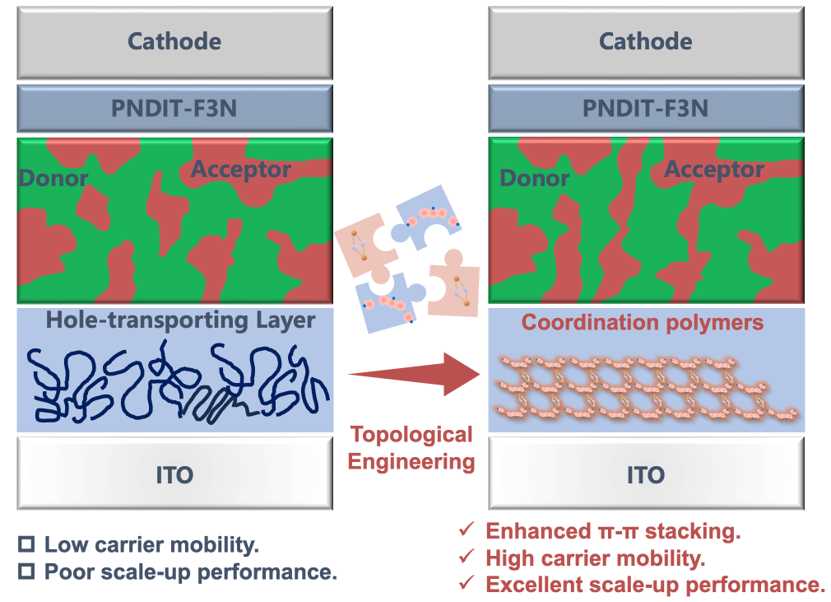
Schematic diagram: Topology-Engineered Coordination Polymers Enhance Hole Transport in Organic Solar Cells
Contact:
Prof. ZHOU Huiqiong
National Center for Nanoscience and Technology (NCNST)
E-mail: zhouhq@nanoctr.cn

