


In the quantum model of the atom, electrons are described by wave functions and exist around the nucleus in the form of a probability distribution, forming an "electron cloud". The negative charge of the electrons screens the positive charge of the nucleus, making the atom electrically neutral. The electron cloud has a real spatial scale, typically on the order of angstroms. This naturally raises an analogous question: when a localized spin exists in a system, can it also attract surrounding electron spins with the opposite orientation and form a quantum spin structure similar to an electron cloud?
In 1964, Jun Kondo proposed the Kondo effect to explain the anomalous low-temperature resistance behavior observed in dilute magnetic alloys. According to this theory, magnetic impurities in a metal interact with the spins of conduction electrons through antiferromagnetic exchange coupling. At low temperatures, the localized magnetic moment is collectively screened by a large number of surrounding electrons, forming a spatially extended quantum many-body entangled state known as the "Kondo cloud". Because spin-exchange interactions are generally weaker than Coulomb interactions, the size of the Kondo cloud can be far larger than the atomic scale, theoretically reaching the micrometer range.
However, unlike ordinary charge distributions, the Kondo cloud cannot be directly imaged easily. In theory, it is usually described by dynamic spin-correlation functions, which are difficult to measure directly in experiments. Therefore, although the Kondo effect is of great importance in quantum many-body theory, strongly correlated electron systems, unconventional superconductivity, and quantum information, whether the Kondo cloud truly exists in metals and how it can be directly detected remain major challenges in condensed matter physics.
Recently, researchers from the National Center for Nanoscience and Technology and Peking University constructed a mirror-symmetric device consisting of a superaligned carbon nanotube array, a metallic molybdenum strip, and another superaligned carbon nanotube array. They found that the resistance of the molybdenum strip exhibited unusual and intriguing temperature-dependent behavior: the resistance–temperature curves were closely related to the width of the molybdenum strip. When the strip width varied from 0.3 to 1.2 micrometers, the resistance minima occurred at different temperatures, but the Kondo effect was observed in all cases, with a similar Kondo temperature of 107.8 K. When the strip width varied from 1.5 to 3.0 micrometers, the Kondo effect was also observed, but with a similar Kondo temperature of 15.8 K.
Combined with numerical renormalization group calculations, the researchers attributed these phenomena to two distinct coupling modes of Kondo clouds. When the molybdenum strip is relatively wide, Kondo clouds induced by the open ends of adjacent carbon nanotubes on the same edge undergo intra-edge coupling, forming a low-Kondo-temperature plateau. When the strip width is reduced to a certain scale, Kondo clouds from the two opposite edges overlap spatially, leading to inter-edge coupling and producing a high-Kondo-temperature plateau. Through control experiments, including introducing a groove in the middle of the molybdenum strip and fabricating single-sided carbon nanotube array–molybdenum devices, the team further verified the physical picture of inter-edge and intra-edge coupling. Based on these findings, they proposed the concept of an insulating core of the Kondo cloud and obtained the dependence of its size on temperature in the range of 2–400 K.
This work provides new experimental evidence for Kondo clouds and their coupling in metallic systems. It shows that Kondo clouds can not only be detected through carefully designed micro- and nanoscale devices, but can also be regulated by device geometry. The discovery offers a new experimental platform for understanding quantum many-body correlations, spin-entangled states, and strongly correlated electron transport, while also providing new ideas for future research in spintronics and quantum information devices.
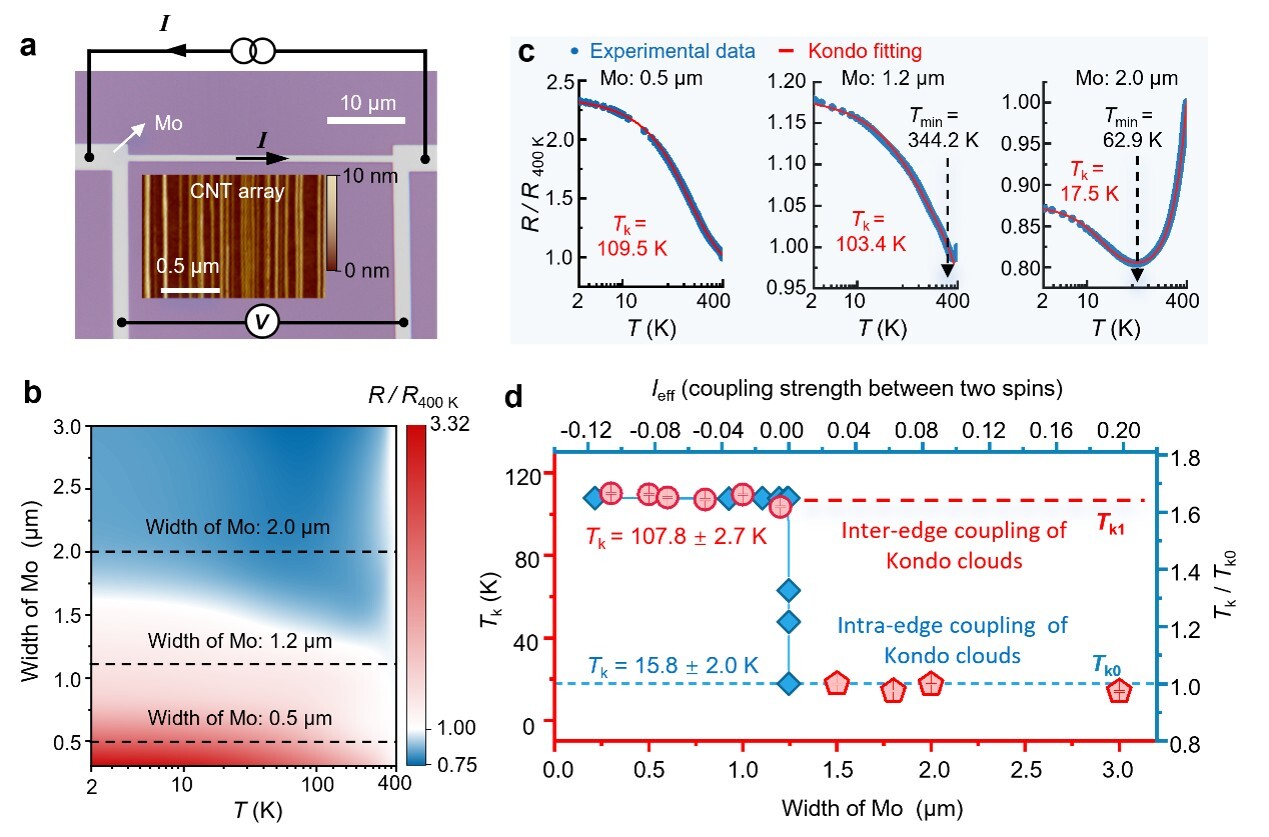
a) Optical and atomic force microscopy images of the device structure. b) Dependence of device resistance on the molybdenum strip width and temperature. c) Resistance–temperature curves for molybdenum strip widths of 0.5, 1.2, and 2.0 μm. The blue data points represent experimental results, while the red curves show theoretical simulations based on the Kondo effect. d) The Kondo temperature exhibits two distinct plateaus, corresponding to two different coupling modes of the Kondo cloud.

