


Drawing inspiration from the silk-spinning and hunting behavior of spiders, a joint research team from the National Center for Nanoscience and Technology (NCNST) and the Institute of Chemistry, Chinese Academy of Sciences (ICCAS), has developed a biomimetic peptide self-assembly system that wraps around mitochondria in nanofibrous networks.
In this work, publised in PNAS, a mitochondria-targeting functional peptide was conjugated with a photosensitizer/sonosensitizer and loaded into homologous exosomes derived from glioma cells. The system leverages the native ability of exosomes to cross the blood-brain barrier (BBB) to deliver the nanomedicine directly to brain tumor tissues. Once inside the glioma cells, the functional peptides are released from the exosomes and precisely target the mitochondrial surface. In the mildly acidic tumor microenvironment, these peptides rapidly self-assemble into nanofibers that physically entangle the mitochondria. Upon ultrasound stimulation, the system generates a high volume of reactive oxygen species (ROS) to efficiently disrupt the mitochondrial structure at near-zero distance, ultimately triggering tumor cell death.
This process, from exosome release to the entanglement of mitochondria by peptide nanofibers, mirrors how spiders spin silk to wrap their prey, thereby significantly enhancing the selective delivery and localized therapeutic impact of ROS. In both subcutaneous and orthotopic patient-derived xenograft (PDX) mouse models, the system demonstrated remarkable tumor suppression capabilities with no significant toxic side effects observed, showcasing excellent biosafety.
By integrating molecular biomimicry with in situ self-assembled nanofibers and sonodynamic therapy, this approach provides a promising new pathway to improve the therapeutic efficacy against glioma.
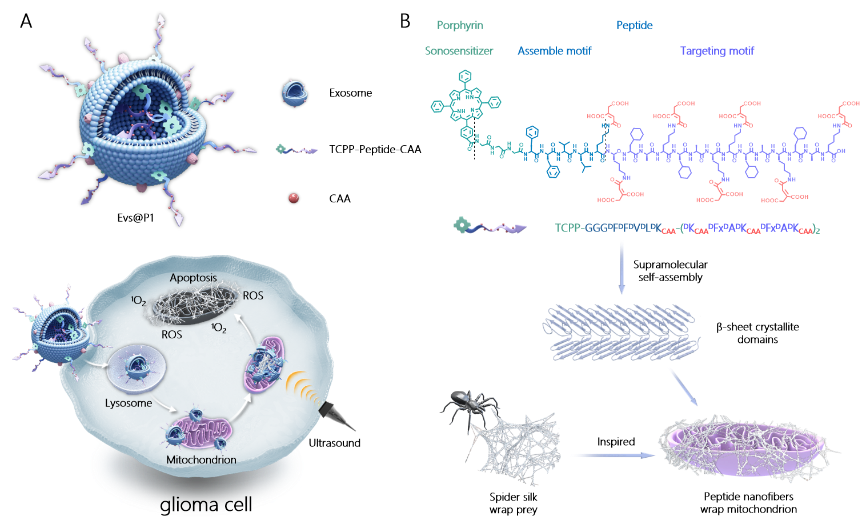
Schematic diagram of the molecular design of "spider peptide" (P1) and its spider web entrapment mode applied for killing brain glioma cells (Image by ZHANG Suling et al.).
Contact: YANG Yang
National Center for Nanoscience and Technology (NCNST)
E-mail: yangyang@nanoctr.cn

