


In a study published in Nature Nanotechnology, a research team led by Prof. LIANG Xing-Jie from the National Center for Nanoscience and Technology (NCNST) of the Chinese Academy of Sciences, in collaboration with a team led by Prof. TENG Gao-Jun from the Southeast University's Zhongda Hospital, developed a vascular endothelium antioxidative nanoscavenger for acute thrombosis prevention, featuring ROS chemotaxis, imperceptible bleeding risk, and high efficiency and biosafety.
Acute arterial thrombosis is a major cause of high morbidity and mortality globally. Antiplatelet therapy is a widely used preventive strategy in clinical practice for patients at high risk of thrombosis. However, these drugs that inhibit platelet activation also interfere with physiological hemostasis, resulting in a significant bleeding risk.
Disrupted redox homeostasis plays a pivotal role in initiating thrombosis. This is supported by the correlation between elevated ROS and vascular injury in both patients and rat models with acute thrombosis. Yet, few preventive strategies have targeted this initial oxidative stage.
In this work, a ROS-chemotactic nanoscavenger (MDCP), formed by crosslinking catalase and melanin was proposed to prevents acute thrombosis by protecting vascular endothelial cells from oxidative stress. With the innate enzymatic activities, pre-injected MDCP can specifically enrich in the injured blood vessels through ROS gradient-induced enzyme chemotaxis, and scavenges overproduced ROS in an enzyme activity-dependent manner. This process suppresses ROS-induced endothelial apoptosis, preserves endothelial integrity, and prevents collagen exposure, thereby inhibiting platelet activation and thrombus formation.
By modulating vascular redox homeostasis instead of directly interfering with platelet function, MDCP presents a promising antithrombotic alternative that mitigates the bleeding risk of current clinical antithrombotic drugs.
Given that ROS elevation is a common feature in various cardiovascular diseases, this antioxidant nanoscavenger may represent a universal antithrombotic strategy applicable to both venous or arterial thrombosis, with the potential to further inhibit thrombus progression and recurrence.
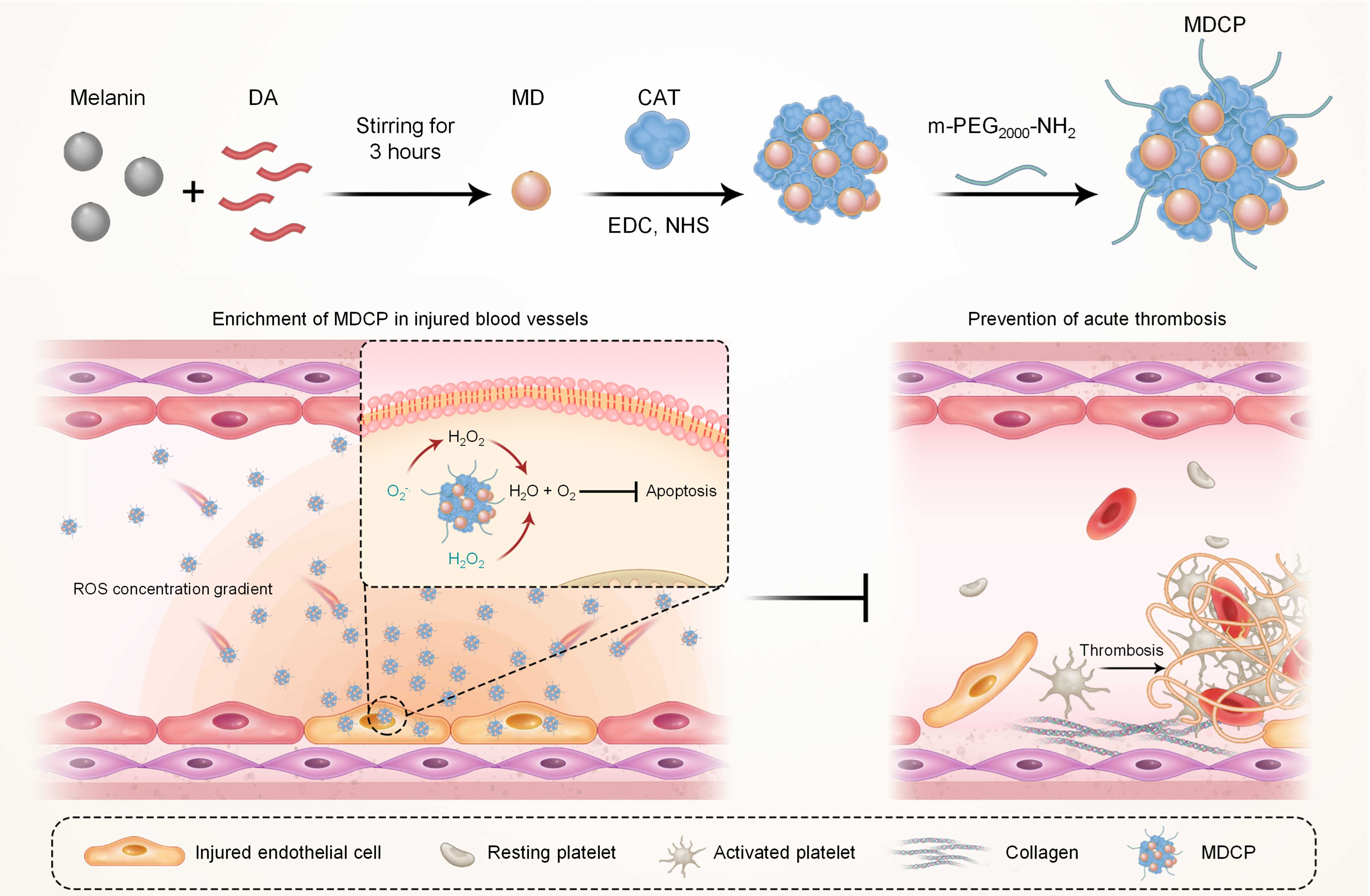
Schematic diagram: MDCP designed for acute thrombosis prevention (Image by LIANG Xing-Jie et al)
Contact: LIANG Xing-Jie
National Center for Nanoscience and Technology (NCNST)
E-mail: liangxj@nanoctr.cn

